


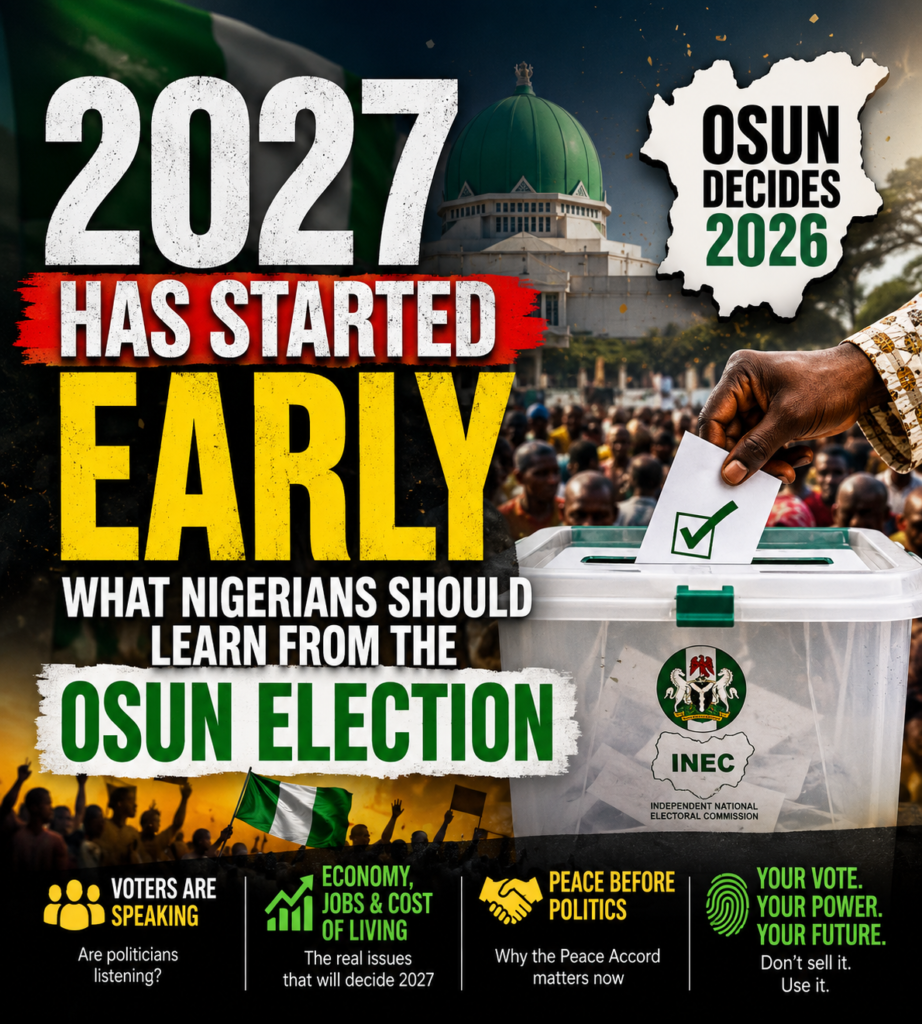

Nigeria may still be months away from the 2027 general election, but one thing is already clear: the political battle has begun.
The clearest evidence is coming from Osun State.
The August 15 governorship election was more than a contest for the Osun Government House. It has become an early political signal for parties, politicians and voters preparing for the much bigger battle ahead.
Governor Ademola Adeleke of the Accord Party was declared the winner after securing 511,067 votes, defeating the All Progressives Congress candidate, Bola Oyebamiji, who polled 444,815 votes.
The margin was significant, but the bigger story is not simply who won or who lost.
The bigger story is what the election is telling Nigeria about 2027.
And perhaps the most important lesson is this:
Political structures alone may no longer be enough to guarantee victory.
For years, Nigerian politics has placed enormous emphasis on political structures — governors, party leaders, lawmakers, local government leaders, political godfathers and influential individuals.
These structures remain important. But ultimately, elections are decided by voters.
The Osun result has already triggered political debate about whether established political structures are enough to guarantee electoral victory.
Former APC chairman in Niger State, Jonathan Vatsa, reportedly warned President Bola Tinubu against relying excessively on governors and political elites ahead of 2027. He argued that the President needs to reconnect with ordinary Nigerians.
Whether one agrees with his political position or not, the underlying message deserves attention.
A politician can have powerful allies in Abuja and still struggle to connect with the ordinary Nigerian standing in a market, sitting in a danfo, running a small business or searching for employment.
Increasingly, the Nigerian voter is asking a simple question:
“What have you done for people like me?”
That question could become one of the most important questions of the 2027 election.
Table of Contents
The Economy Will Be on the Ballot
Nigeria’s politics cannot be separated from the country’s economic reality.
For millions of Nigerians, politics is not primarily about political theory, party colours or campaign slogans.
It is about food.
It is about rent.
It is about school fees.
It is about transportation.
It is about electricity.
It is about healthcare.
It is about jobs.
It is about security.
A politician may speak for hours about economic reforms, but the ordinary Nigerian will ultimately judge those reforms by what happens in the home.
Can the family afford food?
Can the business survive?
Can a graduate find employment?
Can parents pay school fees?
Can a worker afford transportation to work?
These are the questions that matter.
This is why the 2027 election could become increasingly focused on economic experience rather than political promises.
A voter may not understand every detail of monetary policy, but that voter knows whether the cost of living has become easier or harder.
A trader knows whether customers are buying.
A small business owner knows whether operating costs are sustainable.
A young graduate knows whether opportunities exist.
And these experiences influence how people vote.
Voter Turnout Will Matter
Another important lesson from Osun is voter participation.
INEC records show that Osun had more than 2.3 million registered voters, while approximately 1 million votes were cast during the election.
That means a substantial number of registered voters did not participate.
This should concern political parties and Nigerians alike.
Elections are not won by people who simply complain about politics.
They are won by people who show up.
Economist and former banker Atedo Peterside has argued that strong voter turnout is one of the best safeguards against electoral malpractice.
His argument is important because democracy becomes weaker when citizens withdraw from the process.
If Nigerians want better leadership, participation must go beyond social media.
Register.
Collect your PVC.
Verify your details.
Understand the candidates.
Ask questions.
Vote.
And after the election, continue to demand accountability.
Democracy cannot be outsourced to politicians.
Technology Has Changed Nigerian Elections
Another significant development from the Osun election is the growing importance of technology and transparency.
INEC’s Result Viewing Portal, known as IReV, allows election stakeholders and members of the public to view polling-unit results uploaded electronically.
During the Osun election, the pace of result uploads attracted public attention, with some results appearing faster than others.
This matters because Nigerian voters are no longer willing to simply hear an election result and accept it without asking questions.
They want to see the evidence.
They want transparency.
They want to know what happened at the polling unit.
Social media has completely transformed the information environment.
A voter can photograph a result sheet and share it with thousands of people within seconds.
A video from a polling unit in a remote community can become a national conversation within minutes.
A suspected irregularity can attract public attention before officials have even responded.
This means the 2027 election will likely be one of Nigeria’s most closely watched elections ever.
Peace Must Be More Than a Ceremony
There is another important development.
On August 18, political parties and presidential candidates gathered in Abuja for the first National Peace Accord ahead of the 2027 general elections.
The timing could hardly be more significant.
The formal campaign period begins on August 19.
Nigeria is therefore moving almost directly from the Osun election into the formal 2027 campaign season.
The National Peace Accord is a welcome development.
But Nigerians should ask a difficult question:
What happens after the signatures and speeches?
A peace accord is meaningful only when political actors respect its principles when elections become difficult.
Nigeria does not need peace agreements that look impressive on television but disappear when political interests are threatened.
The country needs politicians who can accept defeat.
It needs supporters who can disagree without becoming violent.
It needs security agencies that protect voters without becoming instruments of political intimidation.
It needs institutions that treat candidates fairly.
And it needs citizens who refuse to allow politicians to turn neighbours into enemies.
Speaking at the peace accord ceremony, Peter Obi called for peaceful and issue-based campaigns and urged politicians to conduct themselves in a manner worthy of the offices they seek.
That principle should not belong to one political party.
It should belong to Nigeria.
The Problems We Must Not Ignore
While the Osun election was largely peaceful in many areas, reports also raised concerns about vote-buying, intimidation, technical difficulties and isolated incidents of violence.
INEC also cancelled results from some polling units in Ife Central following reported over-voting.
These issues should not be ignored simply because an election produced a declared winner.
A democracy is not judged only by who wins.
It is also judged by how the people arrive at that result.
If voters are induced with money, democracy suffers.
If citizens are intimidated, democracy suffers.
If technology fails without adequate explanation, public confidence suffers.
If political violence becomes normal, democracy suffers.
And when citizens lose confidence in elections, the damage extends far beyond one election.
What Should Nigerians Expect From 2027?
Perhaps the biggest lesson from Osun is that Nigerians should not approach 2027 as spectators.
The election should not simply be about APC versus opposition.
It should not become North versus South.
It should not become Christian versus Muslim.
And it certainly should not become a situation where people believe their party must win at all costs.
The real contest should be about ideas.
Who has a credible economic plan?
Who can create jobs?
Who can improve security?
Who can strengthen institutions?
Who can reduce corruption?
Who understands the realities of small businesses?
Who can improve education?
Who can provide better healthcare?
Who has a credible plan for electricity?
Who can protect Nigeria’s democracy?
And perhaps most importantly:
Who can be trusted with power?
Young Nigerians Will Matter
Nigeria’s young population could play a major role in determining the character of the 2027 election.
Young Nigerians have unprecedented access to information.
They can compare Nigeria with other countries instantly.
They can investigate politicians.
They can challenge political narratives.
They can organize online and mobilize offline.
They are also increasingly unwilling to accept political promises simply because those promises are delivered at expensive campaign rallies.
A politician who wants the support of young Nigerians in 2027 will need more than a social-media team.
They will need to answer a much deeper question:
“What future are you offering us?”
Osun Is a Signal, Not a Prophecy
There is an important distinction Nigerians must make.
It would be irresponsible to claim that because one party won Osun, that party or its allies will automatically win the presidency in 2027.
Nigeria is too politically complex for that kind of mathematics.
A presidential election involves 36 states and the Federal Capital Territory, each with different political histories, interests, demographics, candidates and local issues.
Osun is not Nigeria.
But Osun is still important.
It shows that voters can surprise political establishments.
It shows that political calculations can fail.
It shows that turnout matters.
It shows that local issues matter.
It shows that voters are watching.
And it shows that the road to 2027 may not follow the script political elites have already written.
The Real Message From Osun
Perhaps the most important message from Osun is not directed at President Bola Tinubu, Governor Ademola Adeleke, the APC, Accord or any other political party.
It is directed at Nigerian voters.
Your vote matters.
But your vote matters most when it is informed.
Do not sell it for ₦10,000.
Do not sell it for ₦50,000.
Do not exchange it for a bag of rice or a few items at a campaign rally.
Do not allow ethnic loyalty to prevent you from questioning your preferred candidate.
Do not allow religious loyalty to silence your conscience.
Do not vote simply because someone is popular.
And do not reject a candidate simply because someone you dislike supports them.
Ask questions.
Demand accountability.
Examine records.
Compare policies.
Watch debates.
Study character.
And when election day comes, show up.
Because politicians may spend months designing strategies for 2027.
But at the end of the day, democracy returns to one place:
the polling unit.
2027 Has Started. Nigerians Must Pay Attention.
The Osun governorship election is over.
Ademola Adeleke has secured another term.
But the larger political conversation has only just begun.
With the formal campaign period beginning on August 19 and the National Peace Accord being signed today, Nigeria has entered another important phase of its journey toward 2027.
The question is no longer whether politicians are preparing for 2027.
They are.
The more important question is whether Nigerians are preparing to demand better from them.
The 2027 election should not merely be an election of personalities.
It should be an election of ideas.
It should be an election of competence.
It should be an election of accountability.
And above all, it should be an election where Nigerians remember one fundamental truth:
Political power does not belong to politicians.
It belongs to the people.
Osun has given Nigeria its latest political lesson.
Now the whole country is watching.
2027 has started early. And this time, Nigerians must pay attention.