

Table of Contents
Introduction
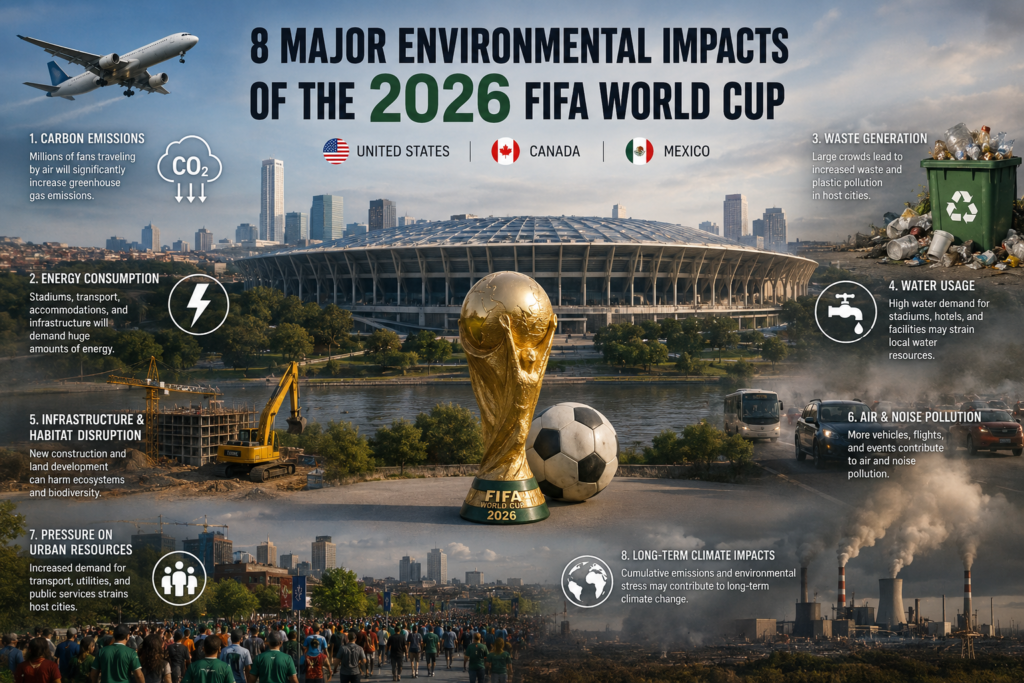
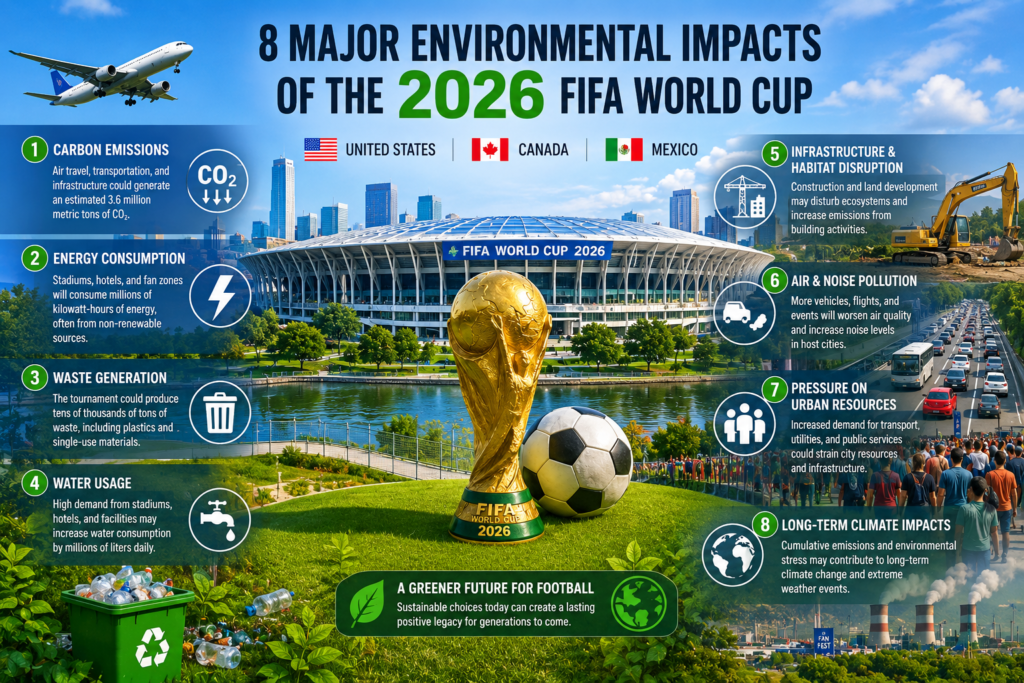
The 8 Major Environmental Impacts of the 2026 FIFA World Cup have become a growing concern among environmentalists, policymakers, and sports stakeholders worldwide. Scheduled to be hosted jointly by the United States, Canada, and Mexico, the 2026 FIFA World Cup will be the largest tournament in football history. For the first time, 48 national teams will compete in 104 matches across 16 host cities, compared to 32 teams and 64 matches in previous editions.
While the tournament is expected to generate billions of dollars in economic activity and attract more than 5 million spectators, experts warn that its environmental footprint could be unprecedented. From carbon emissions and energy consumption to waste generation and pressure on natural resources, understanding the 8 Major Environmental Impacts of the 2026 FIFA World Cup is essential for promoting sustainable sporting events in the future.

1. Massive Carbon Emissions from Air Travel
Among the 8 Major Environmental Impacts of the 2026 FIFA World Cup, air travel is expected to be the largest contributor to greenhouse gas emissions.
According to environmental assessments conducted on previous tournaments, transportation typically accounts for more than 70% of a World Cup’s carbon footprint. With host cities spread across three countries and thousands of kilometers apart, millions of fans will rely on domestic and international flights.
Research indicates that a single long-haul flight can generate between 1 and 3 metric tons of carbon dioxide per passenger. Considering that FIFA expects millions of visitors during the tournament, total emissions from air travel alone could reach several million metric tons of CO₂.
This presents a significant challenge for FIFA’s commitment to reducing the environmental impact of its global events.
2. Increased Energy Consumption Across Host Cities
The second of the 8 Major Environmental Impacts of the 2026 FIFA World Cup is the enormous demand for electricity and energy.
Each stadium requires substantial power for lighting, giant video screens, air conditioning systems, security infrastructure, broadcasting equipment, and communication networks. Modern stadium floodlights can consume more than 2,000 kilowatts of electricity during a single match.
Beyond stadiums, hotels, transportation hubs, media centers, and fan zones will significantly increase energy consumption in host cities. Although some venues utilize renewable energy sources, many facilities will still depend partly on fossil-fuel-generated electricity.
The International Energy Agency estimates that global sports events collectively consume billions of kilowatt-hours annually, making energy efficiency a crucial sustainability issue.
3. Waste Generation and Plastic Pollution
Waste management ranks among the most visible of the 8 Major Environmental Impacts of the 2026 FIFA World Cup.
Large sporting events generate enormous quantities of waste through food packaging, beverage containers, promotional materials, and merchandise. During previous FIFA tournaments, some host cities reported generating hundreds of tons of waste per match day.
Studies show that plastic bottles and food packaging constitute a significant percentage of event-related waste. Without effective recycling systems, much of this material ends up in landfills or pollutes local ecosystems.
With more than 104 matches scheduled, the 2026 FIFA World Cup could generate tens of thousands of tons of waste unless comprehensive waste reduction strategies are implemented.
4. Pressure on Water Resources
Water consumption represents another critical environmental concern.
Each World Cup venue requires water for sanitation facilities, food preparation, maintenance, cleaning operations, and landscaping. Large stadiums can consume hundreds of thousands of liters of water during a single event.
Hotels accommodating visitors also contribute significantly to water demand. Research from the tourism industry suggests that international travelers often consume two to three times more water than local residents due to hotel services and recreational activities.
In regions already facing water stress, increased demand during the tournament could place additional pressure on local water supplies.
5. Infrastructure Expansion and Habitat Disruption
Infrastructure development remains one of the less discussed but highly significant aspects of the 8 Major Environmental Impacts of the 2026 FIFA World Cup.
Although many stadiums already exist, host nations are investing billions of dollars in airport upgrades, transportation networks, roads, hotels, and urban improvements. Construction activities often involve land clearing, vegetation removal, and increased emissions from heavy machinery.
The construction industry is responsible for approximately 37% of global carbon emissions when building operations and materials are combined. Therefore, even limited infrastructure expansion can have measurable environmental consequences.
Sustainable construction practices will be vital to reducing ecological disruption and preserving biodiversity around development zones.
6. Air and Noise Pollution
Another of the 8 Major Environmental Impacts of the 2026 FIFA World Cup is increased air and noise pollution in host communities.
Traffic congestion typically rises significantly during major sporting tournaments. Additional vehicles, buses, taxis, and flights contribute to higher levels of nitrogen oxides, particulate matter, and other pollutants that affect air quality.
Noise pollution generated by crowded stadiums, fan festivals, concerts, and transportation systems can also disrupt local communities and wildlife habitats.
According to the World Health Organization, prolonged exposure to excessive noise can negatively impact both physical and mental well-being, making noise management an important consideration for tournament organizers.
7. Increased Pressure on Urban Resources
Host cities will experience a dramatic surge in demand for essential services during the tournament.
Millions of visitors will rely on public transportation, electricity, water systems, healthcare facilities, and waste management services. For example, some host cities could see temporary population increases of several hundred thousand people during key match periods.
Managing this demand without compromising environmental standards will require careful planning and investment in sustainable urban infrastructure.
Many experts view the tournament as an opportunity to accelerate green transportation initiatives and smart-city solutions that can provide lasting benefits long after the final match.
8. Long-Term Climate Change Implications
The final entry among the 8 Major Environmental Impacts of the 2026 FIFA World Cup concerns its contribution to long-term climate change.
Environmental organizations estimate that major international sporting events can produce millions of metric tons of greenhouse gas emissions throughout their lifecycle. These emissions result from transportation, construction, energy use, accommodation, and waste management activities.
Because the 2026 FIFA World Cup is larger than any previous edition, climate experts have warned that its overall carbon footprint could surpass that of earlier tournaments unless aggressive sustainability measures are adopted.
FIFA and host governments have announced plans to promote renewable energy, carbon reduction initiatives, sustainable transportation, and recycling programs. The effectiveness of these measures will ultimately determine whether the tournament leaves a positive or negative environmental legacy.
Conclusion
The 8 Major Environmental Impacts of the 2026 FIFA World Cup highlight the environmental challenges associated with hosting the world’s biggest sporting event. From carbon emissions and energy consumption to waste generation, water use, habitat disruption, pollution, urban pressure, and climate change, the tournament’s ecological footprint will be closely scrutinized by the global community.
As preparations continue, governments, FIFA, businesses, and fans must work together to address the 8 Major Environmental Impacts of the 2026 FIFA World Cup through sustainable policies and responsible practices. If managed effectively, the tournament could become a benchmark for environmentally responsible sporting events and demonstrate how global entertainment can coexist with environmental stewardship.