


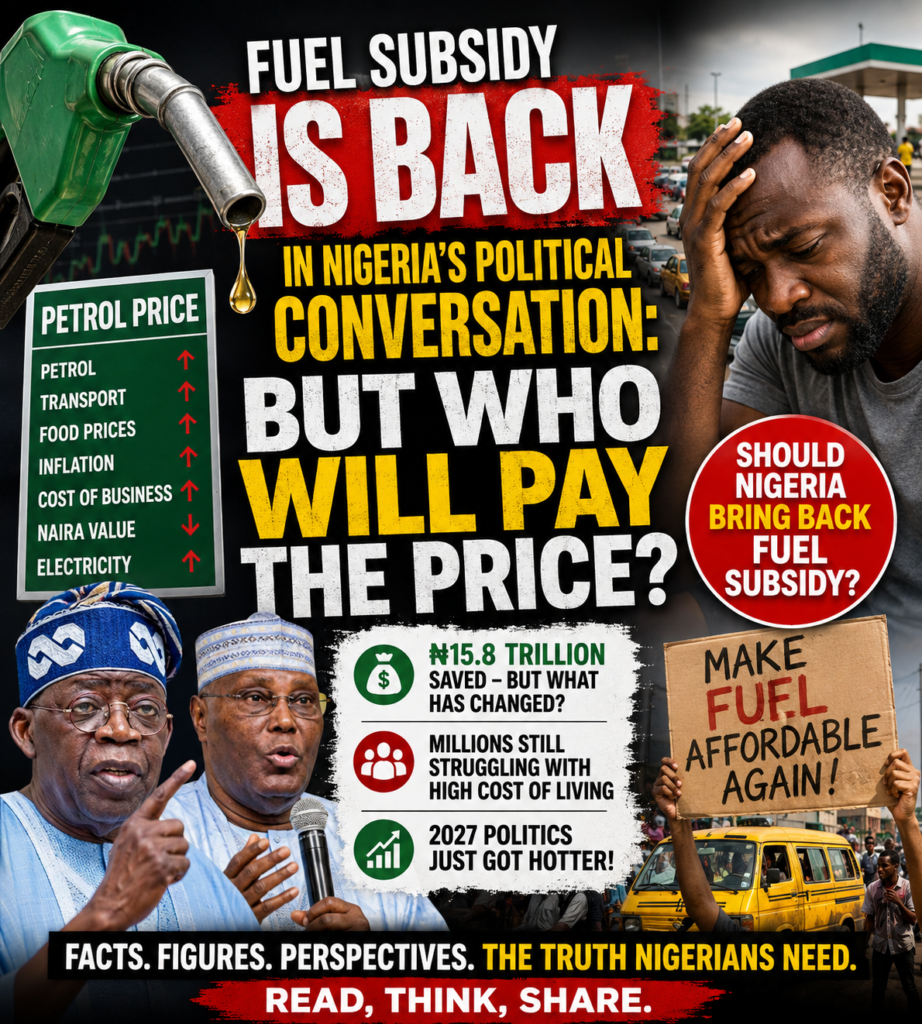
There are some political arguments that never really die in Nigeria.
They only go quiet.
Fuel subsidy is one of them.
For more than two years, Nigerians were told that the era of government-controlled petrol pricing was over. On May 29, 2023, President Bola Ahmed Tinubu announced at his inauguration that “subsidy is gone.” The statement immediately became one of the defining moments of his administration.
Petrol prices rose sharply.
Transport fares increased.
Food distribution became more expensive.
Businesses adjusted their operating costs.
Households began spending more money simply to move from one place to another.
And Nigerians were repeatedly told that the pain was necessary because the country could no longer afford the old system.
But now, as Nigeria moves deeper into the 2027 political season, the subsidy debate has returned with a force that is impossible to ignore.
Former Vice President and African Democratic Congress presidential candidate, Atiku Abubakar, has proposed a new approach to petrol subsidy, arguing that Nigerians need protection from the economic pressure created by high energy costs. The Federal Government has responded aggressively, insisting that restoring the old subsidy model would reverse fiscal gains and recreate the problems that led to its removal.
On August 24, Information Minister Mohammed Idris again warned that restoring petrol subsidy would reverse economic gains made since the reform. The government says the subsidy had become fiscally unsustainable, encouraged arbitrage and placed enormous pressure on public finances.
Atiku and his allies, however, argue that the government cannot simply celebrate fiscal savings while millions of Nigerians continue to struggle with the cost of living. Atiku has defended a targeted, production-oriented subsidy concept and questioned what happened to the resources supposedly freed by subsidy removal.
And suddenly, Nigeria is back to the same fundamental question:
Was removing fuel subsidy the right decision—and if it was, has the government done enough with the money and economic space it created?
That is the question Nigerians should be asking.
Not merely whether subsidy should return.
Not merely whether Atiku is right.
Not merely whether Tinubu is right.
But something much deeper:
How can Nigeria make petrol affordable without returning to a system that drains public resources?
That is where the real debate begins.
Table of Contents
The Subsidy Debate Is No Longer Just About Petrol
It is tempting to think of fuel subsidy as a simple argument about the price of petrol.
It is not.
Fuel subsidy is really an argument about the Nigerian economy itself.
When petrol becomes expensive, transportation becomes expensive.
When transportation becomes expensive, moving food from farms to cities becomes more expensive.
When logistics become more expensive, businesses increase their prices.
When businesses increase prices, households spend more.
When households spend more on necessities, they have less money for education, healthcare, savings, investment and other needs.
That is why the petrol price Nigerians see at a filling station is only the beginning of the story.
The consequences travel through the entire economy.
A farmer in Kaduna may feel the impact because the cost of transporting fertiliser or produce rises.
A trader in Lagos may feel it because her supplier increases delivery charges.
A manufacturer may feel it because diesel, petrol, logistics and electricity costs rise.
A student may feel it because transportation to school becomes more expensive.
A civil servant may feel it because the cost of commuting consumes a larger part of monthly income.
A family in a rural community may feel it because the price of food arriving from another state has increased.
So when politicians debate subsidy, Nigerians should not listen only to the argument about government expenditure.
They should also ask:
What is the cost of expensive energy to the Nigerian household?
That cost is real.
And even the Presidency has acknowledged it.
In defending the government’s position, Special Adviser Bayo Onanuga acknowledged that higher petrol and energy costs have placed significant pressure on households, transport operators and businesses.
That admission matters.
Because the subsidy debate cannot be reduced to the argument that Nigerians simply do not understand economics.
They do.
They understand the economics of an empty wallet.
Why Did Nigeria Remove the Subsidy in the First Place?
To understand today’s argument, Nigerians must first understand yesterday’s problem.
For years, Nigeria sold petrol below what it actually cost to bring the product to consumers.
Government absorbed the difference.
The idea was simple: make petrol cheaper for Nigerians.
But the system became increasingly expensive.
The World Bank had warned that Nigeria’s petrol subsidy was fiscally unsustainable and socially unfair. Its analysis showed that the subsidy consumed a huge share of government revenue and could crowd out spending on healthcare, education and social protection.
By 2022, the burden had become particularly severe.
The Information Minister said Nigeria spent about $10 billion on fuel subsidies in 2022, when oil production was declining and government revenues were under pressure.
The World Bank similarly reported that the subsidy represented about 2.2 percent of GDP in 2022 and had risen to 32.4 percent of total government revenues.
And there was another problem.
Cheap petrol created incentives for smuggling.
If petrol was significantly cheaper in Nigeria than in neighbouring countries, smugglers could buy it cheaply in Nigeria and move it across the border for profit.
In other words, some of the money Nigeria spent supposedly helping Nigerians was not necessarily benefiting Nigerians.
It was leaking through a system that had become difficult to control.
That is why the argument for subsidy removal was not invented by the Tinubu administration.
Successive governments had struggled with the issue.
The difficulty was always the same:
Everyone knew the subsidy was expensive. Nobody wanted to be the government that removed it.
Then Tinubu did it.
And Nigerians immediately felt the consequences.
“Subsidy Is Gone”—But the Pain Remained
When President Tinubu declared that subsidy was gone, the announcement was followed by an immediate increase in petrol prices.
That increase changed the economics of daily life.
The cost of transportation increased.
Businesses adjusted.
Food prices were affected by higher logistics costs.
Household budgets were squeezed.
The government knew this would happen.
The argument was that the short-term pain would eventually produce long-term economic stability.
This is where the debate becomes complicated.
Because there are two different questions.
Question one: Was the subsidy financially sustainable?
The evidence suggests the old system had become extraordinarily expensive.
Question two: Did removing it automatically make Nigerians better off?
That answer is much less straightforward.
The reforms improved the government’s fiscal position in important ways, but they also produced severe short-term hardship.
Reuters reported last week that Finance Minister Taiwo Oyedele described the reforms as helping avert a possible economic collapse, while acknowledging that the measures intensified the cost-of-living crisis in the short term.
This is the paradox at the centre of Nigeria’s economic debate.
A reform can be economically necessary and still be socially painful.
Those two statements can both be true.
And pretending otherwise does not help Nigerians.
So Where Did the Money Go?
This may be the single most important question in the entire debate.
The Federal Government recently released details of what it describes as the savings generated by the subsidy removal.
According to Finance Minister Taiwo Oyedele, subsidy removal mobilised approximately ₦15.8 trillion for the Federation between June 2023 and December 2025.
But there is an important clarification.
The ₦15.8 trillion was not sitting in a government bank account waiting to be distributed.
It represented resources made available to the Federation as the government stopped funding the old petrol subsidy arrangement.
The Federal Government’s own economic reform scorecard says the ₦15.8 trillion was distributed across the Federation, with approximately:
- ₦5.43 trillion to the Federal Government
- ₦6.52 trillion to states
- ₦3.88 trillion to local governments
The government says these figures represent the estimated distribution of the subsidy savings.
This distinction is extremely important.
Because Nigerians hear:
“Nigeria saved ₦15.8 trillion.”
And naturally ask:
“Where is the ₦15.8 trillion?”
But the government is saying that the money was not one giant pot of cash.
It created fiscal space.
It reduced the amount of money government would otherwise have needed to spend on petrol price support.
It also increased the resources available to different levels of government.
The Federal Government says that when subsidy savings were combined with additional revenue and borrowing, it had approximately ₦20.4 trillion in incremental resources, while additional expenditure during the period reached about ₦30.64 trillion.
That means something important.
The argument is not simply:
“Government removed subsidy and received ₦15.8 trillion.”
The actual fiscal story is much more complicated.
And Nigerians deserve to understand that complexity.
But Nigerians Have a Right to Ask What Changed
This is where government accountability enters the conversation.
Suppose government tells a struggling family:
“We are taking away this benefit because it is no longer sustainable. The money will be used more productively.”
That family may accept the sacrifice.
But after two or three years, the family will reasonably ask:
What did we gain?
That is precisely the question Nigerians are asking about subsidy removal.
If the government says the reform created fiscal space, Nigerians should be able to see the benefits.
If states received additional money, citizens should ask what their state governments did with it.
If local governments received additional resources, citizens should ask what happened to those resources.
If the Federal Government gained additional fiscal space, Nigerians should ask whether schools, hospitals, roads, security, public transportation and social protection improved.
This is not an argument against subsidy removal.
It is an argument for accountability after subsidy removal.
There is a major difference.
The government may be correct that the old subsidy regime was unsustainable.
But that does not give government permission to stop explaining how the benefits of reform are being converted into better lives.
This Is Where Atiku’s Argument Becomes Politically Powerful
Atiku Abubakar has identified the most politically sensitive part of the subsidy debate.
He is not simply saying:
“Petrol should be cheap.”
His argument is essentially that government should intervene in the petroleum value chain in a more targeted way so that Nigerians can benefit from lower production and distribution costs.
Details of his economic proposal indicate a move away from the old import-based subsidy model toward a production-oriented approach tied to domestic refining. His proposal reportedly includes conditions, fiscal limits and independent auditing mechanisms.
That is important.
Because the debate is often presented as though there are only two options:
Option A: Remove subsidy completely.
Option B: Bring back the old subsidy system.
But perhaps there is a third possibility.
Could Nigeria design a strict, transparent, temporary and targeted intervention that reduces the cost of petrol without returning to the corruption and fiscal burden associated with the old system?
That is a legitimate policy question.
The government says no—that any return to subsidy would recreate the same fiscal problems.
Atiku and his supporters say the country can design a different model.
The public deserves to hear the technical details of both arguments.
Not just the political insults.
The Government Has a Difficult Question for Atiku
The Presidency has asked a very straightforward question:
Who will pay for the subsidy?
Bayo Onanuga put the issue bluntly, asking what the new petrol price would be under a restored subsidy and who would absorb the difference between the market cost and the regulated pump price.
That is a legitimate question.
If petrol costs more to produce or distribute than the price consumers pay, someone must absorb the difference.
It could be the Federal Government.
It could be the states.
It could be the oil industry.
It could be financed through borrowing.
It could be funded through increased taxes.
Or some combination of these.
But there is no magic money.
If government pays ₦300 to subsidise every litre, that money has to come from somewhere.
And if government pays ₦500, the same question remains.
If millions of litres are consumed every day, the numbers become enormous very quickly.
That is why any serious proposal to restore a subsidy must answer five questions:
How much will it cost?
Who will pay?
How long will it last?
Who will benefit?
How will Nigerians know that the money is not being stolen?
Without answers to these questions, “subsidy” remains a political slogan rather than an economic policy.
But Government Has an Equally Difficult Question to Answer
Now let us turn the question around.
If subsidy removal was necessary to save the economy, then the government has a responsibility to explain something equally important:
When will Nigerians feel the benefit?
That is the question the government cannot escape.
It is not enough to say:
“The economy is improving.”
Improving for whom?
It is not enough to say:
“Foreign investors are returning.”
What does that mean for the average Nigerian?
It is not enough to say:
“Government revenue has increased.”
What has increased government revenue done for the average family?
It is not enough to say:
“Subsidy was unsustainable.”
Most Nigerians can accept that argument if it is properly explained.
But Nigerians want to know what comes next.
If the old subsidy system was bad, what is the new system doing to make life better?
If the government saved resources, where are the roads?
Where are the reliable buses?
Where are the cheaper energy alternatives?
Where is the stronger public transportation system?
Where are the expanded social protection programmes?
Where is the reduction in logistics costs?
Where is the cheaper electricity?
Where is the increased purchasing power?
Because Nigerians did not wake up one morning and say:
“We want to understand fiscal consolidation.”
They woke up and said:
“How do we survive?”
The Real Problem May Be Energy, Not Just Subsidy
Perhaps Nigeria has spent too much time arguing about subsidy and not enough time solving the bigger problem.
Nigeria’s fundamental problem is that energy remains expensive.
Petrol is expensive.
Diesel is expensive.
Electricity is expensive.
Gas distribution remains inadequate.
Transportation is expensive.
And businesses pay for all of it.
If Nigeria could produce and distribute energy more cheaply, the pressure on households would fall even without a conventional petrol subsidy.
This is why domestic refining is so important.
If Nigeria produces more of its own petroleum products, it can reduce dependence on imported refined products and potentially reduce exposure to foreign exchange pressures.
The Dangote refinery and other domestic refining investments have changed the structure of Nigeria’s petroleum industry.
The Presidency argues that Nigeria is moving toward a model in which domestic crude is processed locally and refined products are supplied to the domestic market.
That transition could be more important than the subsidy argument itself.
Imagine a Nigeria where:
- More crude is refined locally.
- Petrol supply becomes more predictable.
- Competition increases.
- Transportation costs fall.
- CNG becomes widely available.
- Public transport becomes more efficient.
- Electricity becomes more reliable.
- Logistics become cheaper.
- Businesses spend less on energy.
That would provide Nigerians with something a subsidy alone cannot guarantee:
a more productive economy.
The CNG Question Cannot Be Ignored
The government has promoted Compressed Natural Gas as one alternative to petrol, particularly for commercial transportation.
The Presidency says CNG can be significantly cheaper than petrol for vehicles converted to use it and points to its use by commercial and industrial operators.
The idea makes economic sense in principle.
Nigeria has enormous gas resources.
If buses, taxis, trucks and other commercial vehicles can use cheaper domestic gas, transport costs could eventually decline.
But there is a problem.
Transition takes time.
You cannot simply tell a bus driver who owns a petrol-powered vehicle:
“Petrol is expensive. Go and use CNG.”
Where is the conversion kit?
Who pays for it?
Where are the filling stations?
What happens to people outside major cities?
Who trains technicians?
What happens when equipment breaks down?
How long does conversion take?
How much does the vehicle owner lose during the transition?
These are the practical questions that determine whether an economic policy succeeds.
A policy can be excellent on paper and still fail on the street.
And Nigeria has seen enough policies fail between Abuja and the motor park.
The Politics of Petrol Has Changed
There is another reason this debate is exploding now.
2027 has arrived politically.
Nigeria has entered the formal campaign period for the next presidential election, and fuel subsidy is one of the most emotionally powerful economic issues any politician can touch.
Reuters reported that Tinubu’s re-election campaign is unfolding amid intense scrutiny over his economic reforms, with the removal of fuel subsidy and naira reforms at the centre of public debate.
This means Nigerians must be careful.
A subsidy promise can be good policy.
It can also be political strategy.
And the two are not mutually exclusive.
A politician can genuinely believe subsidy should return and simultaneously understand that the promise will resonate with voters.
That is politics.
But Nigerians must not allow the political nature of the debate to prevent serious economic analysis.
The question should not be:
“Who promised subsidy?”
The question should be:
“What exactly is the proposal, how much will it cost, how will it be administered, and what will Nigerians receive in return?”
That is how voters should evaluate economic promises.
Do Not Allow Politicians to Make Nigerians Choose Between Pain and Bankruptcy
This may be the biggest lesson from the entire controversy.
Nigeria should not be forced into a false choice.
We should not be told:
“Either Nigerians suffer or Nigeria collapses.”
And opposition politicians should not tell Nigerians:
“We will make fuel cheap again,”
without explaining how.
There must be a middle ground.
Nigeria needs economic discipline.
But it also needs social protection.
Nigeria needs fiscal responsibility.
But it also needs affordable transportation.
Nigeria needs market reforms.
But it also needs competition and consumer protection.
Nigeria needs domestic refining.
But it also needs affordable energy.
Nigeria needs increased revenue.
But it also needs accountability for public spending.
Nigeria needs investment.
But it also needs Nigerians to actually feel the benefits of economic growth.
That is the balance responsible leadership should pursue.
The Most Dangerous Thing Would Be to Return to the Old System Without Fixing Its Problems
There is a legitimate reason to be cautious about a full return to the old subsidy regime.
The old system was vulnerable to abuse.
It created enormous fiscal obligations.
It encouraged arbitrage and smuggling.
It made government finances vulnerable to oil prices and exchange-rate movements.
And it was difficult for ordinary citizens to determine exactly how much subsidy was being paid and to whom.
The World Bank’s assessment that the old petrol subsidy was opaque and fiscally unsustainable should not simply be dismissed.
If Nigeria restores subsidy, it must not restore the old opacity.
If government decides to subsidise petrol, Nigerians should be able to see:
How much is being paid.
Who is receiving it.
How many litres are being subsidised.
What the economic cost per litre is.
What the government is contributing.
What the refiner or marketer is contributing.
When the programme will end.
What independent auditors have found.
Without that transparency, the country could easily return to the same problem.
The Bigger Question: Should Government Subsidise Fuel or People?
This may be the most important policy question Nigerians should debate.
Instead of subsidising every litre of petrol consumed by everyone, should government directly support vulnerable Nigerians?
Consider the difference.
A wealthy Nigerian with several large vehicles consumes more petrol.
A transport company consumes enormous quantities.
A middle-class family consumes some.
A poor household may consume very little petrol directly but suffer heavily from the increased cost of transportation and food.
A universal petrol subsidy therefore does not necessarily mean that the poorest Nigerians receive the largest benefit.
The World Bank has previously argued that petrol subsidies can disproportionately benefit richer households because higher-income households generally consume more fuel.
This creates an uncomfortable question:
Why should government spend enormous public resources subsidising consumption when some of the biggest beneficiaries are people who can afford to pay market prices?
Perhaps the better approach is to subsidise mobility, food, public transportation, healthcare and vulnerable households.
Imagine if instead of spending billions making petrol cheaper for everyone, government invested heavily in:
- Mass transit.
- CNG buses.
- Rail transportation.
- School feeding.
- Direct cash transfers.
- Rural roads.
- Food production.
- Healthcare.
- Public education.
- Electricity infrastructure.
The average Nigerian may care less about whether petrol itself is subsidised if the total cost of living becomes significantly lower.
That is the real objective.
Affordability—not ideology.
Nigerians Should Demand a “Subsidy Dividend”
Here is where government policy should become measurable.
If Nigerians were asked to make a sacrifice by removing subsidy, then Nigerians should eventually receive what could be called a subsidy dividend.
Not necessarily cash in their bank accounts.
But visible improvements.
A subsidy dividend could mean:
Cheaper public transportation.
Better roads.
Lower logistics costs.
More reliable electricity.
Better healthcare.
Improved schools.
More efficient social protection.
More jobs.
Stronger domestic manufacturing.
Lower inflation.
Higher household purchasing power.
That is how citizens ultimately judge reform.
Not by government spreadsheets.
Not by press conferences.
Not by economic jargon.
By their lives.
The ₦15.8 Trillion Debate Should Not End With a Press Conference
The government deserves credit for providing more detail about the subsidy savings.
For years, Nigerians asked:
Where is the subsidy money?
Now the government has provided figures.
But disclosure should not be the end of the conversation.
It should be the beginning.
If ₦15.8 trillion was mobilised for the Federation, Nigerians should be able to track the economic impact.
How much went to each state?
How much went to local governments?
What did states do with the additional resources?
What did the Federal Government spend its share on?
What measurable outcomes have emerged?
What was spent on wages?
What went into infrastructure?
What went into electricity support?
What went into social programmes?
What prevented the money from being lost to waste?
The government’s reform scorecard provides figures on resources and expenditure, but the political debate now needs to move from “How much was saved?” to “What did Nigerians receive for the sacrifice?”
That is a much more useful question.
And Atiku Must Answer His Own Questions Too
Opposition politicians cannot simply point at hardship.
They must present credible alternatives.
If Atiku’s proposal is to introduce a targeted or production-based subsidy, Nigerians should demand the full economic model.
How much will it cost annually?
Which refineries will qualify?
How will domestic crude be priced?
How will government prevent manipulation?
How will auditors verify production?
How will government prevent a new subsidy cartel?
How long will the subsidy last?
What happens if crude prices rise?
What happens if the naira depreciates?
What happens if domestic refining capacity falls?
What happens if government revenue declines?
What happens when the subsidy becomes politically difficult to remove?
These questions do not make Atiku’s proposal invalid.
They make it serious.
Any politician asking Nigerians to vote for a major economic policy should be prepared to explain the arithmetic.
And Tinubu Must Answer His Own Questions Too
The same standard applies to the government.
The administration cannot say:
“Trust the reform.”
Nigerians have already paid for it.
They have paid through higher transport costs.
They have paid through increased household expenses.
They have paid through business pressures.
They have paid through reduced purchasing power.
They have paid through years of economic adjustment.
So the government must demonstrate that the reform is producing something tangible.
It must show Nigerians not only that the subsidy was expensive but also that the alternative system is delivering better results.
Because ultimately, economic reform is not an academic exercise.
It is supposed to improve human lives.
What Should Nigerians Believe?
Perhaps the answer is: do not blindly believe either side.
Listen to the government.
Listen to Atiku.
Listen to economists.
Listen to business owners.
Listen to transport operators.
Listen to workers.
Listen to traders.
Listen to farmers.
Listen to young Nigerians.
Then examine the numbers.
That is what democracy requires.
The government may be right that the old subsidy system was unsustainable.
Atiku may be right that government must find ways to reduce the burden of petrol prices.
Both arguments can contain elements of truth.
The question is which policy produces the best outcome for Nigeria.
The Real Subsidy Nigeria Needs
Nigeria may not need to return to the subsidy system of yesterday.
But Nigeria absolutely needs relief.
That distinction is critical.
Nigerians are not obsessed with the word “subsidy.”
They are obsessed with affordability.
A mother does not care whether government calls the intervention a subsidy, tax credit, social transfer, transport support, production incentive or energy relief.
She wants to know whether she can afford to feed her children.
A commercial driver does not care about economic terminology.
He wants to know whether the cost of fuel will leave him with enough money after working all day.
A business owner wants to know whether the cost of moving goods will allow the business to survive.
A student wants to know whether transportation to school is affordable.
A worker wants to know whether salary can still cover the cost of getting to work.
That is why the conversation should move beyond:
“Subsidy or no subsidy?”
The better question is:
“What economic system can make life affordable without bankrupting the country?”
That is the question Nigeria should be debating.
2027 Will Put the Question Directly Before Nigerian Voters
The political significance of this debate cannot be ignored.
Fuel subsidy is now part of the 2027 electoral conversation.
The government is defending the reforms.
The opposition is attacking aspects of the reforms.
Candidates are proposing alternatives.
And Nigerians are watching.
The next election will therefore be about more than personalities.
It will be a referendum, at least in part, on economic direction.
Do Nigerians believe the current reforms are working?
Do they believe the hardship is temporary?
Do they believe the government has managed the resources responsibly?
Do they believe the opposition has better alternatives?
Do they believe subsidy should return?
Do they want market-driven petrol pricing?
Do they want targeted government intervention?
These are not questions politicians should answer on behalf of voters.
Voters should answer them themselves.
So, Should Nigeria Bring Back Fuel Subsidy?
Here is my answer:
Not the old subsidy system.
Nigeria should not return to an opaque, open-ended system where government carries an unpredictable bill while citizens struggle to determine exactly where the money goes.
But that does not mean government should simply stand aside while petrol prices destroy household purchasing power.
There must be intervention.
There must be relief.
There must be accountability.
There must be competition.
There must be domestic refining.
There must be cheaper transportation.
There must be alternative energy.
There must be protection for vulnerable Nigerians.
And there must be a clear connection between economic reform and the quality of life of citizens.
If a targeted production incentive can reduce the cost of locally refined petrol without recreating the corruption and fiscal burden of the old subsidy regime, then Nigerians deserve to hear the proposal.
If the government believes its current approach will produce cheaper and more stable energy in the long run, then it must show Nigerians the roadmap.
If both sides claim to have the solution, then let the numbers speak.
Nigeria Cannot Afford Another Empty Promise
The greatest danger in this debate is not whether subsidy returns.
The greatest danger is that politicians turn Nigerians’ economic pain into campaign ammunition without providing a sustainable solution.
Nigerians have heard enough promises.
They have heard:
“Things will get better.”
They have heard:
“Just be patient.”
They have heard:
“The reforms will soon yield results.”
They have heard:
“Vote for us and we will fix the economy.”
What Nigerians need now is different.
They need numbers.
They need timelines.
They need accountability.
They need measurable targets.
They need transparency.
They need policies that can survive beyond election cycles.
And they need leaders willing to tell them not only what they want to hear, but what the country can actually afford.
The Final Question Is Not “Who Is Right?”
The fuel subsidy argument has become another political battlefield between the Tinubu administration and Atiku Abubakar.
But Nigerians should refuse to allow the conversation to become another political shouting match.
There is something more important at stake.
The future of Nigeria’s economy.
If subsidy removal saved public finances, Nigerians deserve to benefit.
If subsidy restoration can genuinely reduce hardship without destroying public finances, Nigerians deserve to hear the evidence.
If domestic refining can reduce costs, government should accelerate it.
If CNG can reduce transportation expenses, infrastructure should be expanded.
If direct social protection works better than universal fuel subsidy, it should be properly funded.
If states received additional resources, citizens should demand accountability.
If the Federal Government received additional resources, citizens should demand accountability.
And if politicians make promises about subsidy in 2027, Nigerians should ask one question before cheering:
“Show us the mathematics.”
Because Nigeria has tried politics without mathematics before.
It produced debt.
It produced scarcity.
It produced corruption.
It produced uncertainty.
It produced promises.
And ultimately, ordinary Nigerians paid the bill.
Nigeria Needs Affordable Fuel—But It Also Needs a Sustainable Country
There is nothing wrong with wanting cheap petrol.
There is nothing wrong with wanting government to protect vulnerable citizens.
There is nothing wrong with demanding relief from economic hardship.
But Nigeria must be careful not to solve today’s pain by creating tomorrow’s crisis.
The old subsidy system may have made petrol cheaper at the pump, but it also placed a massive burden on public finances and created serious opportunities for abuse.
The removal of subsidy has reduced that fiscal burden, but it has also imposed enormous pressure on households and businesses.
That is the uncomfortable truth.
Both sides of the debate have something Nigerians need to hear.
The government is right to warn against returning to a system that previously became financially unsustainable.
The opposition is right to point out that economic reforms cannot be judged only by government balance sheets while citizens continue to struggle.
The government must prove that reform produces a better future.
The opposition must prove that its alternative is financially credible.
And Nigerians must demand the evidence from both.
The Petrol Pump Is Now a Political Scoreboard
Every time a Nigerian drives into a filling station, politics becomes real.
Every time a driver calculates whether he can afford another trip, politics becomes real.
Every time a trader increases the price of goods because transportation costs have risen, politics becomes real.
Every time a parent decides whether there is enough money left after transport and food to pay school fees, politics becomes real.
This is why fuel subsidy will remain one of the biggest political issues in Nigeria.
It is not merely about petrol.
It is about how government choices enter the pockets, kitchens, businesses and futures of ordinary Nigerians.
And as the 2027 election approaches, Nigerians will be watching closely.
They will listen to the government.
They will listen to the opposition.
They will listen to candidates promising cheaper fuel.
But increasingly, they will ask:
Who will actually pay for it?
And perhaps an even more important question:
Who will make sure Nigerians finally get value for what they have already paid?
That is the debate Nigeria needs.
Not subsidy politics.
Not propaganda.
Not insults.
Not campaign slogans.
A serious national conversation about the price of energy, the cost of government, the future of the Nigerian economy and the quality of life of the Nigerian people.
The subsidy may be gone.
But the consequences of that decision are still very much with us.
And now, as 2027 begins to take shape, Nigerians are being offered another choice.
Bring back subsidy.
Keep the reform.
Modify it.
Replace it.
Or build something entirely different.
Whatever option Nigeria chooses, one thing should no longer be negotiable:
The Nigerian people must not be the ones who pay endlessly while politicians argue about who was right.
Nigeria needs an energy policy that Nigerians can afford.
It needs an economic policy that the government can sustain.
It needs a subsidy policy—if there is one at all—that can be audited.
And above everything else, it needs leaders who understand that economic reform is not successful simply because government finances look better on paper.
Reform is successful when the lives of the people become better.
That is the standard Nigerians should use.
And that is the question every presidential candidate should be prepared to answer before asking Nigerians for their votes in 2027:
“How exactly will you make life more affordable—and how exactly will you pay for it?”
Because this time, Nigerians should not settle for promises.
They should demand the mathematics.