


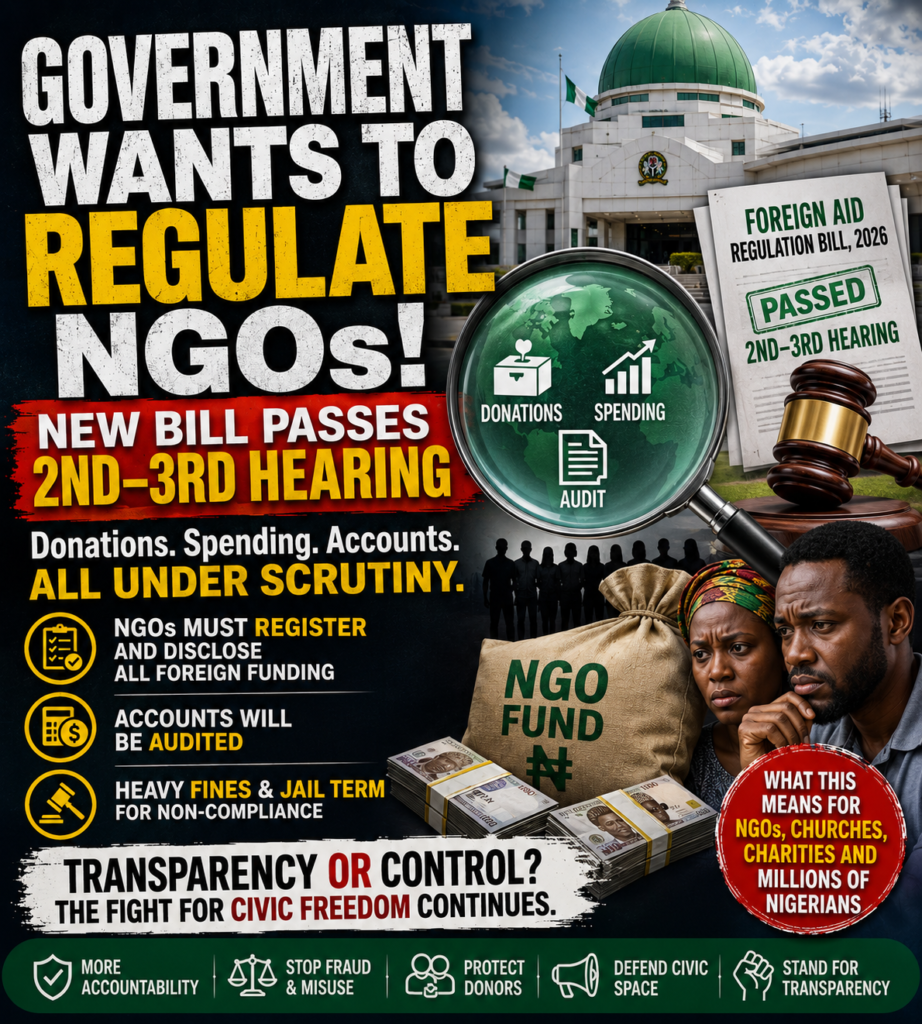
A new legislative battle is quietly developing in Nigeria, and this time it is not about fuel, elections, taxation or cryptocurrency.
It is about NGOs, charities, foundations, religious organisations, humanitarian groups and other bodies that receive money from outside Nigeria.
The question is simple, but the consequences could be enormous:
How much control should the Nigerian government have over money donated to organisations working in Nigeria?
The debate has intensified around Senate Bill 1034, officially titled the Foreign Aid (Regulation, Coordination, Transparency and Disclosure) Bill, 2026, sponsored by Senator Ibrahim Hassan Dankwambo of Gombe North.
The Senate passed the bill for second reading on July 22, 2026. It was then referred to committees for further legislative work and public hearing. As of August 26, 2026, it has not passed third reading and has not become law. This distinction is important because some social-media reports have suggested that the bill has already passed through second and third readings. Available legislative tracking and recent reporting do not support that claim.
But make no mistake: the bill is serious.
If eventually enacted substantially in its current form, it could create a new regulatory framework under which foreign grants, donations, humanitarian assistance and other forms of foreign aid would face registration, disclosure, monitoring, auditing and sanctions.
And that is why NGOs, churches, humanitarian organisations, civil-society groups and donor-funded projects across Nigeria are paying attention.
Table of Contents
The Government Says It Wants Accountability. Critics Fear Control.
At the heart of the controversy is a question that is difficult to dismiss:
Should organisations receiving millions or even billions of naira from foreign donors be able to receive and spend that money without comprehensive government visibility?
Supporters of the bill say the answer is no.
They argue that foreign assistance entering Nigeria should be properly documented, tracked and subjected to accountability mechanisms.
During the Senate debate, supporters pointed to concerns about donor-funded projects being implemented outside government planning and budgeting systems, duplication of projects and inadequate information about where foreign assistance goes.
Channels Television reported that the Senate’s proposed framework would require registration of foreign aid in a national database, public disclosure of funding agreements, disbursement schedules, project outcomes and audit reports, while also providing sanctions for diversion, misuse, false disclosure and unapproved projects.
Senator Dankwambo argued that Nigeria’s foreign-aid management system is fragmented and insufficiently transparent, with donor-funded projects sometimes scattered across ministries, departments and agencies.
The National Assembly Library Trust Fund, reporting on the bill, similarly said the proposal is intended to create a unified framework for donor tracking, disclosure and coordination.
The government’s argument therefore sounds straightforward:
If money is entering Nigeria for development, humanitarian or social purposes, Nigerians should be able to know where it came from, where it went and what it achieved.
That is a difficult principle to oppose.
But then comes the other side of the argument.
What Exactly Is the Government Trying to Regulate?
This is where Nigerians need to look beyond the headline.
The bill is not simply saying:
“NGOs should submit their accounts.”
Its proposed scope is much broader.
According to recent reporting on the bill, an entity receiving foreign aid would have to register with a proposed Foreign Aid Regulatory Commission, or FARC, within 30 days of receiving the funding. It would also have to disclose information including the source and amount of the funding, its purpose and conditions, implementing partners and reports on utilisation.
The information would then form part of a proposed National Foreign Aid Register.
The bill’s definition of foreign aid is also broad. It reportedly covers financial or technical assistance from foreign governments, international organisations and private foreign entities, including grants, donations, technical assistance, concessional loans and humanitarian support.
That means the debate is much bigger than conventional NGOs.
It potentially reaches a broad ecosystem of organisations and institutions receiving foreign support.
And that is where things become complicated.
The Proposed Commission Would Have Significant Powers
One of the most important features of the bill is the proposed creation of a regulatory body with substantial oversight responsibilities.
The proposed commission would have powers relating to:
- Registration of foreign aid recipients
- Monitoring of foreign-funded activities
- Requesting information from recipients
- Auditing
- Inspection of aid-funded projects
- Monitoring utilisation of funds
- Public disclosure
- Administrative sanctions
- Regulatory enforcement
Recent reporting by The PUNCH says the proposed commission could conduct audits and inspections of aid-funded projects and impose administrative sanctions.
The bill also proposes annual independent audits, with audit reports submitted to the commission and the National Assembly.
This is where the legislation becomes particularly consequential.
It means the question is no longer simply:
“Should NGOs be accountable?”
The question becomes:
“Who should have the power to determine whether an NGO has complied, what information it must disclose, when it can be audited and what happens if the regulator believes it has violated the rules?”
That is a much bigger constitutional and governance question.
And There Are Serious Financial Penalties
The bill does not merely recommend transparency.
It reportedly contains penalties.
According to The PUNCH, an individual convicted of an offence under the proposed legislation could face a fine of at least ₦5 million, imprisonment for up to five years, or both.
A corporate body could face a minimum ₦20 million fine, as well as suspension or revocation of its operating licence.
That is significant for small and medium-sized NGOs.
Imagine a small Nigerian foundation receiving a foreign grant to provide educational materials to 500 children.
If its administrative team misunderstands a reporting requirement, misses a deadline or fails to satisfy a regulatory condition, the consequences under a strict regulatory framework could potentially be severe.
This is why the design of the law matters as much as its objective.
The Government’s Case: Where Does the Money Go?
There is a legitimate question behind the bill that Nigeria should not ignore.
Nigeria receives enormous amounts of foreign development assistance.
That money supports programmes in:
- Healthcare
- Education
- Agriculture
- Humanitarian relief
- Poverty reduction
- Climate action
- Governance
- Women and children
- Human rights
- Emergency response
- Refugee and internally displaced persons’ support
Premium Times reported that thousands of NGOs operate in Nigeria and that donor-funded interventions cover sectors including health, education, agriculture, governance, climate change, human rights and poverty reduction.
Some of these organisations operate in extremely difficult environments.
Some work in communities where government services are weak or practically absent.
Others provide emergency humanitarian assistance in conflict-affected areas.
That makes financial accountability extremely important.
If a donor gives $1 million to an organisation to provide medical assistance to vulnerable Nigerians, Nigerians have every right to ask:
Was the money actually spent on medical assistance?
How many people benefited?
How much went to administration?
How much went to salaries?
How much was spent on vehicles?
How much went to consultants?
How much went directly to beneficiaries?
Were procurement procedures followed?
Did the project actually happen?
Those are legitimate questions.
And NGOs themselves should not be afraid of them.
An NGO Is Not Above Accountability
This point needs to be made clearly.
Being a non-governmental organisation does not mean being beyond scrutiny.
An NGO is not automatically honest because its mission statement sounds noble.
A charity can be fraudulent.
A foundation can misuse funds.
A fake humanitarian organisation can be established to receive donations.
An organisation can exaggerate the number of beneficiaries it has reached.
A donor can be deceived.
Money intended for vulnerable people can be diverted.
These problems are real.
During the Senate debate, lawmakers raised concerns about fraudulent or pseudo-NGOs being used to collect money, as well as inadequate scrutiny of foreign assistance.
That concern should not simply be dismissed as government propaganda.
Nigeria has legitimate financial-crime and accountability problems.
If public money must be audited, large corporations must keep financial records and banks must comply with anti-money-laundering rules, there is a reasonable argument that organisations handling significant donor funds should also operate transparently.
But there is a critical distinction.
Accountability is not the same thing as government control.
And that is where the real battle begins.
The NGOs Are Not Saying “Leave Us Alone”
One of the most interesting parts of this debate is that civil society groups are not generally arguing that foreign funding should be secret.
They are questioning how the government intends to achieve transparency.
The Executive Director of the Nigeria Network of NGOs, Oyebisi Babatunde Oluseyi, has argued that civil society organisations are not opposed to transparency and accountability but that the proposed framework could duplicate existing regulatory mechanisms and increase the burden on nonprofits.
That distinction is important.
The debate is therefore not:
Government = accountability
versus
NGOs = secrecy.
It is more complicated.
The real argument is:
How do we achieve accountability without creating excessive state power over independent organisations?
Nigeria Already Has Laws Governing NGOs
This is another part of the story that deserves attention.
NGOs in Nigeria do not currently operate in a legal vacuum.
Incorporated organisations are subject to the Companies and Allied Matters Act (CAMA) 2020 and other applicable laws and regulatory requirements.
Depending on their activities and funding structures, organisations may also interact with tax, banking, anti-money-laundering and other regulatory frameworks.
The Nigeria Network of NGOs argues that nonprofits already face several compliance obligations and that creating another commission could result in overlapping regulatory responsibilities.
The concern is straightforward:
Nigeria already has several government institutions.
If another commission is created with overlapping powers, will Nigerians actually get better accountability?
Or will NGOs simply spend more money complying with paperwork?
That is a legitimate question.
The Existing Donor-Tracking System Is Also Part of the Debate
There is an even more interesting issue.
The Nigeria Network of NGOs says Nigeria already has the Nigeria Development Cooperation Dashboard, operated by the Federal Ministry of Budget and Economic Planning, which tracks donor-funded interventions and provides information on aid disbursements.
If that system already exists, lawmakers need to explain precisely what problem the new commission will solve that existing institutions cannot solve.
This should be one of the most important questions during the committee stage and public hearing.
A good law should not simply create another office.
It should solve a clearly identified problem.
If existing institutions are failing, perhaps the answer is to strengthen them.
If their mandates are unclear, clarify them.
If their databases do not communicate with one another, integrate them.
If their enforcement mechanisms are weak, improve them.
Creating another agency should not automatically be the first solution.
But There Is Something Else Nigerians Should Worry About: Who Controls the Regulator?
This is perhaps the most important question in the entire debate.
Suppose the commission has the power to:
- Register an organisation
- Inspect its projects
- Audit its finances
- Demand information
- Impose sanctions
- Suspend operations
- Influence whether it continues to operate
Then the regulator becomes extremely powerful.
Now imagine an NGO investigating corruption.
Imagine another monitoring elections.
Imagine another documenting police abuses.
Imagine another campaigning for environmental rights.
Imagine another challenging a government policy.
Imagine another working with communities affected by land acquisition.
What happens if the regulator and the NGO disagree about whether a foreign-funded project is aligned with national priorities?
Who decides?
What safeguards exist?
Can the organisation appeal?
How quickly?
To whom?
Can the regulator suspend an organisation before a final determination?
Can the regulator demand sensitive information about beneficiaries?
Can information about vulnerable people be publicly disclosed?
These are not theoretical questions.
They are exactly the kinds of questions that determine whether regulation strengthens democracy or weakens it.
The 30-Day Rule Could Be a Problem for Emergency Aid
One of the strongest criticisms concerns the proposed requirement to register foreign aid within 30 days.
Human rights organisations argue that a rigid registration deadline could create difficulties for emergency assistance.
Imagine a human-rights defender facing an immediate security threat.
A donor sends emergency funds for relocation.
Or a lawyer receives emergency support to defend a detained activist.
Or a humanitarian organisation receives urgent funding after a disaster.
Or an organisation needs immediate assistance for survivors of violence.
Should the organisation first worry about a bureaucratic registration deadline?
The Nigerian Human Rights Defenders Network, Partnership for Justice, Front Line Defenders, West African Human Rights Defenders Network and Protection International have argued that the 30-day requirement could create problems for emergency protection funding.
Their recommendation is not necessarily “no regulation.”
They have called for a differentiated and expedited mechanism for emergency protection-related funding.
That is a proposal worth considering.
Good regulation should understand the difference between:
a five-year development programme
and
money sent tonight to save someone’s life.
Public Disclosure Could Also Create Security Risks
Transparency sounds unquestionably good.
But not every piece of information should necessarily be public.
Suppose an NGO provides support to victims of terrorism.
Suppose the beneficiaries are witnesses.
Suppose an organisation is documenting human-rights violations.
Suppose a donor is funding legal assistance to people facing threats.
If the identities of partners, beneficiaries or project locations are automatically placed on a public register, transparency could inadvertently create danger.
The five human-rights organisations that opposed SB 1034 specifically warned that mandatory disclosure of implementing partners and funded activities could expose defenders, witnesses and survivors to surveillance, harassment or retaliation.
This is where regulation requires sophistication.
Not all information should be treated equally.
A regulator should be able to see sensitive information when legally justified without necessarily making every detail publicly searchable.
There must be privacy safeguards.
The “National Interest” Question
Another major issue concerns the requirement that foreign-funded activities align with Nigeria’s development priorities.
At first glance, this sounds reasonable.
Why should foreign money fund projects that undermine national development?
But who determines what is “aligned”?
Consider a human-rights organisation documenting abuse by a government agency.
Is that aligned with national development?
Consider an environmental group opposing a mining project.
Is that aligned?
Consider a women’s rights organisation challenging a discriminatory practice.
Is that aligned?
Consider an election-monitoring organisation publishing evidence that embarrasses powerful politicians.
Is that aligned?
This is where wording becomes crucial.
A vague legal standard can create enormous discretion.
The human-rights groups opposing the bill argue that the alignment requirement could potentially be used against organisations whose activities are politically sensitive or critical of government.
That concern deserves serious consideration during legislative scrutiny.
Nigeria’s 2027 Elections Make the Timing Particularly Sensitive
There is another reason this debate is attracting attention now.
Nigeria is moving toward the 2027 general elections.
Civil-society organisations traditionally play major roles during elections.
They monitor voting.
They conduct voter education.
They observe campaigns.
They investigate electoral irregularities.
They train citizens.
They advocate for electoral reform.
Some receive foreign grants to perform these functions.
That makes the regulatory question particularly sensitive.
If foreign-funded NGOs suddenly face a powerful new regulator with authority over their registration, audits and operations, critics worry that organisations could become cautious about taking positions that may anger those in power.
The coalition of 90 civil-society and human-rights organisations that called for withdrawal of the bill explicitly raised concerns about the timing of the legislation and its possible effect on civic space ahead of the 2027 elections.
The government, however, would argue that national security and financial transparency do not disappear simply because an election is approaching.
Both arguments deserve to be heard.
The Religious Organisations Question
Another aspect Nigerians should watch carefully is the potential reach beyond conventional NGOs.
Recent reporting says the bill’s definition of foreign aid includes financial or technical assistance from foreign governments, international organisations and private foreign entities, and covers grants, donations, technical assistance, concessional loans and humanitarian support.
This is why concerns have extended beyond NGOs to other private and religious organisations receiving foreign support.
Human-rights lawyer Chidi Odinkalu has argued that the implications could reach churches, mosques, schools, universities, hospitals and community initiatives depending on how the law is interpreted and implemented.
Whether every one of those organisations would actually fall within the final law would depend on the final wording passed by the National Assembly.
That is precisely why Nigerians should not rely on sensational social-media interpretations.
Read the final text.
Government Regulation of NGO Spending Is Not Necessarily a Bad Idea
This needs to be said clearly.
There is a dangerous tendency in Nigeria to treat every government regulation as an attack on civil society.
That is not intellectually honest.
If an organisation receives ₦500 million for a humanitarian project, there should be accountability.
If a donor gives money for 10,000 schoolchildren, the project should be verifiable.
If funds are meant for medical supplies, they should not end up financing someone’s luxury lifestyle.
If an organisation claims to have constructed 20 boreholes, somebody should be able to verify that the boreholes exist.
If foreign money is being used to finance criminal activities, the government must have the ability to investigate.
There must be financial controls.
There must be audits.
There must be sanctions for fraud.
There must be consequences for diversion.
The question is not whether accountability should exist.
It is how accountability should be designed.
The Government Should Not Be Afraid of Transparency Either
If the government believes that foreign-funded organisations pose a serious national-security risk, it should explain the evidence.
Which gaps exist under the current system?
How much foreign aid is currently unaccounted for?
How many fraudulent NGOs have been identified?
How many donor-funded projects have been duplicated?
How much money has been diverted?
How many organisations have been sanctioned under existing laws?
Which existing agencies failed?
Where exactly does the new commission begin where existing regulators end?
These are the questions Nigerians should ask.
A powerful new law should be justified by evidence.
The Bill Could Also Affect the Future of Philanthropy in Nigeria
This debate is bigger than NGOs.
It could affect philanthropy.
Consider a Nigerian living in the United Kingdom who wants to donate £50,000 to a Nigerian foundation.
Or a Nigerian-American family that wants to finance scholarships in their ancestral community.
Or a foreign foundation that wants to fund a healthcare project in Kano.
Or an international organisation that wants to support flood victims.
The donors will want to know:
How difficult will compliance become?
If receiving foreign donations becomes excessively bureaucratic, some donors may decide to redirect their money elsewhere.
That could hurt Nigerian communities.
At the same time, reputable donors may actually welcome stronger transparency because it reassures them that their money is being used properly.
So regulation could produce two completely different outcomes.
Good regulation could increase donor confidence.
Bad regulation could reduce donor participation.
The difference will be in the details.
What NGOs Should Be Doing Right Now
The bill is not yet law.
Therefore, NGOs should not panic.
But they should prepare.
Every serious NGO should already have:
1. Proper financial records
Every donation should be documented.
2. Clear donor agreements
The source, purpose and conditions of funding should be clear.
3. Bank documentation
Funds should move through traceable channels.
4. Project records
Organisations should be able to demonstrate what was achieved with donor money.
5. Procurement documentation
Receipts, quotations, contracts and payment records should be properly maintained.
6. Independent financial review
Even where the law does not require a particular audit, credible organisations should consider independent financial audits.
7. Governance structures
Boards of trustees and management should understand their fiduciary responsibilities.
8. Conflict-of-interest policies
Nobody should be awarding contracts to themselves or related businesses without proper disclosure and controls.
9. Beneficiary protection
Organisations should avoid unnecessarily exposing vulnerable beneficiaries.
10. Legal monitoring
Every NGO receiving foreign funding should follow the progress of SB 1034 and participate in legitimate consultations and public hearings.
The National Assembly Has an Opportunity to Get This Right
This is perhaps the most important conclusion.
Nigeria does need stronger transparency around foreign funding.
But Nigeria also needs a strong civil society.
These two objectives are not enemies.
They should complement each other.
The National Assembly can create a framework that says:
Yes, foreign money must be disclosed.
Yes, donor-funded projects must be traceable.
Yes, fraud must attract sanctions.
Yes, financial records must be maintained.
Yes, legitimate audits should take place.
But it can also say:
No regulator can arbitrarily shut down an organisation.
No sensitive beneficiary information should automatically become public.
Emergency humanitarian funds must have special treatment.
Regulatory decisions must be appealable.
The regulator must operate under clear statutory limits.
Existing regulatory institutions should be coordinated rather than unnecessarily duplicated.
Civil society should have a meaningful voice in the implementation framework.
That would be a much more balanced approach.
The Most Important Correction Nigerians Need to Know
There is already misinformation circulating around this subject.
Some reports and social-media posts have suggested that the NGO/foreign-aid bill has passed both second and third readings.
That is not the position supported by the current evidence I found.
The Senate passed SB 1034 for second reading on July 22, 2026. The bill was subsequently referred to committees for further consideration and public hearing. Recent reports dated August 26 still describe it as a proposed bill before the Senate, not an enacted law.
Policy and legislative tracking sources likewise indicate that third reading had not been reached.
That means:
NGOs are not currently operating under this proposed FARC law.
The proposed ₦20 million corporate penalty is not currently a new law.
The proposed annual audit requirement is not yet an enacted statutory requirement under SB 1034.
The proposed 30-day foreign-aid registration rule is not currently in force under this bill.
The bill still has to go through the remaining legislative process, including committee consideration, public hearing, further debate and, if eventually passed by the Senate, consideration by the House of Representatives. Any final legislation would also have to complete the constitutional process for becoming law.
That distinction matters enormously.
So, Should Nigerians Support or Oppose the Bill?
Perhaps the smartest answer is:
Do neither blindly. Read it. Examine it. Debate it.
Those who support the bill have a legitimate argument.
Foreign money entering Nigeria should not be a black hole.
Donor funds should be traceable.
Fraudulent NGOs should be exposed.
Money laundering should be prevented.
Humanitarian money should reach the people it was intended to help.
National security matters.
But opponents also have legitimate concerns.
A regulator with excessive discretionary power can become dangerous.
Multiple overlapping agencies can increase bureaucracy.
Public disclosure can expose vulnerable people.
Heavy compliance costs can destroy small organisations.
Broad language around “national priorities” can be abused.
And regulation of funding can become indirect regulation of speech and association if safeguards are weak.
The answer is therefore not to reject accountability.
The answer is to build accountability with guardrails.
The Bigger Question: Who Watches the Watchers?
Nigeria has spent decades creating agencies.
Sometimes the problem is not that there is no law.
Sometimes the problem is that the laws already in existence are poorly implemented.
That should be one of the central questions surrounding SB 1034.
If CAC already has responsibilities over incorporated organisations, strengthen CAC.
If the NFIU already has financial-intelligence responsibilities, strengthen the NFIU.
If SCUML has relevant anti-money-laundering responsibilities, coordinate its work.
If FIRS has tax-related responsibilities, improve information-sharing.
If the Ministry of Budget and Economic Planning already tracks donor-funded interventions, improve that system.
If audits are required, strengthen audit capacity.
If fraudulent NGOs exist, investigate and prosecute them.
The government should be able to explain why a new commission is necessary and what measurable gap it will close.
Nigeria Needs Transparent NGOs — But It Also Needs Independent NGOs
This is the balance Nigeria cannot afford to lose.
NGOs perform functions that governments sometimes cannot or will not perform.
They reach remote communities.
They document abuses.
They provide humanitarian assistance.
They support people living with disabilities.
They work with women and children.
They provide legal assistance.
They educate citizens.
They conduct research.
They hold public institutions accountable.
They support health programmes.
They help communities respond to disasters.
Some of them are excellent.
Some are mediocre.
And, inevitably, some may be fraudulent.
The answer is not to treat them all as criminals.
It is to build a regulatory framework that distinguishes between legitimate organisations and bad actors.
That means risk-based regulation rather than blanket suspicion.
The Bill Could Become a Test of Nigeria’s Democratic Maturity
Ultimately, SB 1034 may become more than a debate about NGO accounting.
It could become a test of whether Nigeria can regulate powerful institutions without suffocating independent voices.
Can government demand transparency without demanding political obedience?
Can it investigate suspicious funding without criminalising legitimate advocacy?
Can it audit donor money without controlling the organisations receiving it?
Can it protect national security without weakening freedom of association?
Can it prevent fraud without creating another bureaucracy?
Can it increase accountability without making Nigeria unattractive to legitimate international donors?
These are the questions that should dominate the public hearing.
Final Verdict: Regulate the Money, But Do Not Regulate the Conscience
Nigeria has every right to ask where foreign money entering the country comes from.
It has every right to know what it is being used for.
It has every right to investigate suspected fraud, money laundering, terrorism financing and diversion of donor funds.
It has every right to demand credible financial records.
And NGOs should not be afraid of legitimate accountability.
But the government must equally understand something fundamental:
An NGO is not an extension of government simply because it receives a foreign grant.
A charity is not automatically a government contractor.
A human-rights organisation is not automatically an enemy of the state.
A foreign donation is not automatically suspicious.
And transparency should not become a mechanism for political control.
Nigeria therefore needs a law that can accomplish two things simultaneously:
Protect public interest and protect civic freedom.
If the National Assembly gets this right, SB 1034 could become a useful framework for ensuring that foreign assistance produces measurable value for Nigerians.
If it gets it wrong, Nigeria could end up with another expensive regulatory institution, more bureaucracy, greater uncertainty for nonprofits and a chilling effect on organisations whose job is sometimes to question those in power.
That is why Nigerians should pay attention now—not after the bill becomes law.
The Senate has already taken the second step.
The committee stage and public hearing are precisely where the details should be challenged, clarified and improved.
And this is where every serious Nigerian should be asking:
If government wants to audit NGOs, who will audit the regulator?
If government wants to know where donor money goes, who will ensure the regulatory system itself remains transparent?
If NGOs must disclose everything, what safeguards will protect vulnerable beneficiaries?
If foreign-funded projects must align with national priorities, who defines those priorities—and who decides when an NGO has violated them?
And perhaps the biggest question of all:
Can Nigeria demand accountability from civil society without weakening the civil society that keeps government accountable?
The answer will determine whether this bill becomes a landmark transparency law—or another chapter in Nigeria’s long-running struggle to find the delicate line between regulation and control.
For now, the bill is not yet law.
But the debate has already begun.
And Nigerians should be watching.
Because this is no longer just about NGOs.
It is about money, power, transparency, national security, democracy—and who gets to decide what happens between all five.
Sources consulted
This article was researched against multiple Nigerian and civil-society sources, including Channels Television, Premium Times, The PUNCH, The Guardian, the National Assembly Library Trust Fund, Nigeria Network of NGOs, West Africa Civil Society Institute and legislative-tracking material. The central procedural point—that SB 1034 passed second reading but has not yet reached third reading as of August 26, 2026—is supported by the National Assembly Library Trust Fund, Premium Times, PUNCH and legislative-tracking sources.
For the government’s case, the Senate debate and proposed transparency mechanisms are documented by Channels Television and the National Assembly Library Trust Fund.
For the concerns raised by civil society and human-rights organisations, I consulted The Guardian, Premium Times, The PUNCH, TheCable, Nigeria Network of NGOs and Front Line Defenders.