


If you have ever received USDT from a client abroad, bought USDC to protect your savings from naira volatility, paid a foreign supplier with a crypto wallet, received money from a relative overseas, traded on a peer-to-peer platform, or simply kept a portion of your money in a dollar-linked digital asset, something significant is happening in Nigeria that you should understand.
It is not another Bitcoin price prediction.
It is not another cryptocurrency exchange controversy.
It is not another argument about whether crypto is the future.
This time, the issue is visibility.
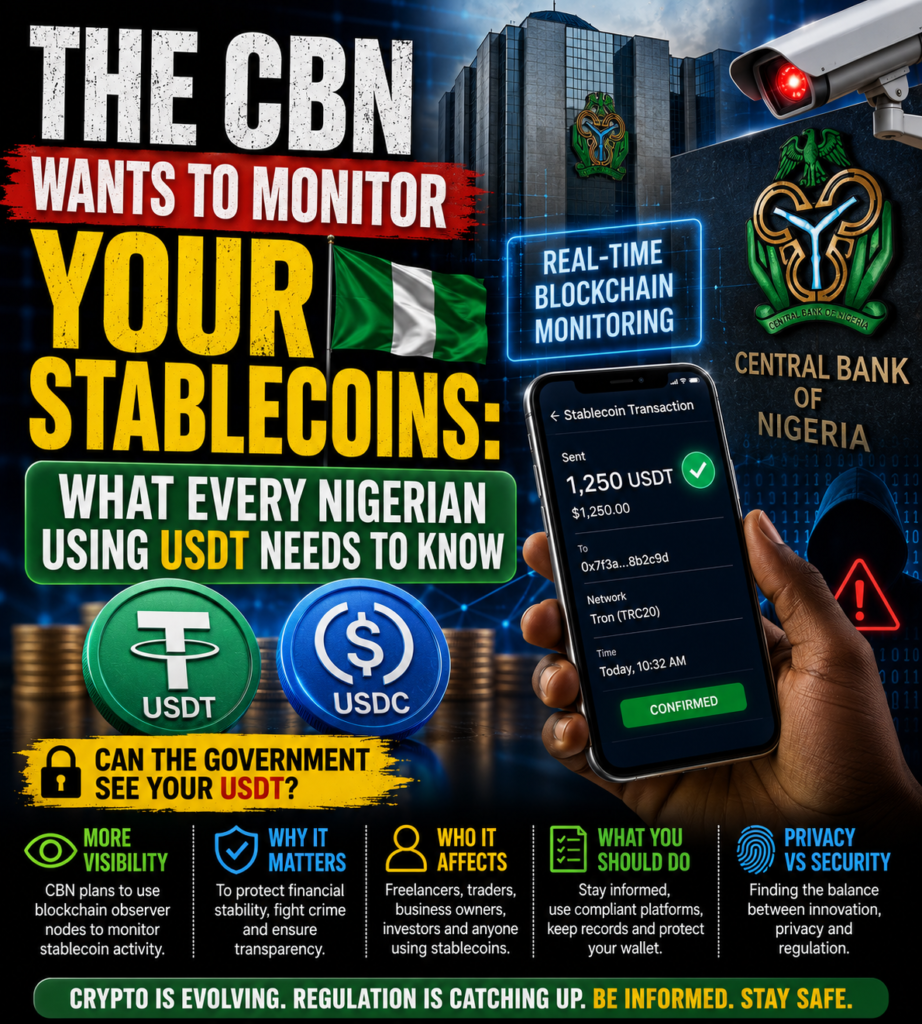
The Central Bank of Nigeria is moving toward a system that could give regulators much greater visibility into stablecoin activity, including the ability to observe transactions directly on supported blockchain networks.
The development is contained in the Central Bank’s Payments System Vision 2028, unveiled in June 2026. Reporting on the plan says the CBN intends to use read-only “observer nodes” on blockchain networks supporting approved stablecoins, allowing it to monitor activity directly rather than relying entirely on information supplied by intermediaries.
That sounds technical.
It is not.
For ordinary Nigerians, it could eventually affect how they send money, receive money, save dollars digitally, run online businesses, use crypto exchanges and interact with financial institutions.
And it raises a question that thousands of Nigerian crypto users are likely to ask:
If I use USDT, can the Nigerian government see my transaction?
The answer is more complicated than a simple yes or no.
But one thing is becoming increasingly clear:
The era when stablecoin activity could be treated as a completely separate world from Nigeria’s regulated financial system is coming under pressure.
And Nigerians who use USDT, USDC and other stablecoins need to understand what that means.
Table of Contents
First, What Exactly Is a Stablecoin?
Before discussing regulation, we need to understand what is being regulated.
A stablecoin is a cryptocurrency designed to maintain a relatively stable value, usually by referencing an asset such as a national currency.
The most common examples relevant to Nigerians are USDT, issued by Tether, and USDC, issued by Circle.
Unlike Bitcoin, whose price can rise or fall dramatically, dollar-linked stablecoins are designed to track the value of the U.S. dollar.
So, in simple terms, someone holding 100 USDT is generally trying to hold something with approximately the economic value of US$100, rather than taking the much greater price risk associated with holding 100 dollars’ worth of Bitcoin.
This makes stablecoins particularly attractive in countries where people are worried about currency depreciation, inflation or difficulties moving money across borders.
And Nigeria has become one of the world’s important markets for this activity.
The International Monetary Fund says Nigeria received approximately $59 billion in crypto-asset inflows between July 2023 and June 2024, ranked second globally in Chainalysis’ 2024 crypto adoption index and sixth in the 2025 edition. The IMF also says stablecoins accounted for more than 65 percent of Nigeria’s crypto inflows in 2024.
That is no longer a niche phenomenon.
Stablecoins are becoming part of how some Nigerians interact with the international economy.
Why Are Nigerians Using USDT So Much?
The answer is partly economic.
For years, Nigerians have faced a complicated relationship with foreign exchange.
The naira has experienced substantial volatility.
Inflation has reduced purchasing power.
Access to foreign currency can sometimes be difficult or expensive.
International payments through conventional channels can involve delays, documentation, intermediary fees and other restrictions.
Stablecoins offer another route.
Imagine a Nigerian freelancer working for a company in the United States.
The client owes the freelancer $1,000.
Instead of relying exclusively on traditional banking or money-transfer channels, the client can send a dollar-linked stablecoin to the freelancer’s digital wallet.
The transaction can settle relatively quickly.
The freelancer can then hold the stablecoin, convert it to naira, use it to make another payment, or send it elsewhere.
That is one reason stablecoins have become attractive.
The IMF describes them as a growing cross-border channel for Nigerian households and small businesses, noting their potential to reduce payment friction for trade and remittances.
This means the Nigerian stablecoin market is not made up only of cryptocurrency speculators.
It includes freelancers.
Online entrepreneurs.
Importers.
Exporters.
Remote workers.
Digital creators.
Families receiving money from abroad.
Technology companies.
Traders.
Investors.
And ordinary people trying to protect part of their purchasing power.
That is why the CBN’s new direction deserves attention.
The CBN Is Not Simply Saying “Crypto Is Illegal”
This distinction is extremely important.
There is a tendency whenever Nigerian regulators announce a crypto-related policy for social media to interpret the news as:
“Government wants to ban crypto.”
That is not what the current direction indicates.
In fact, the CBN is simultaneously creating a regulatory environment in which virtual-asset and stablecoin businesses can be tested under supervision.
The CBN’s second Regulatory Sandbox cohort, launched this month, includes a dedicated Virtual Asset & Stablecoin Financial Services track covering areas such as stablecoin payments, digital wallets, custody, token-based products, exchanges and fiat on/off-ramp services.
That is significant.
A regulator that wanted simply to eliminate the sector would not need to create a controlled environment for companies building stablecoin payment infrastructure.
Instead, the direction appears to be:
“We know this market exists. We want to understand it, supervise it and determine how it fits into the financial system.”
That is a very different approach from simply pretending crypto does not exist.
Then What Does “Monitoring” Actually Mean?
This is where the technical part becomes important.
A blockchain is essentially a distributed public ledger.
Depending on the blockchain involved, transactions can be viewed publicly through blockchain explorers.
You can see a wallet address.
You can see that tokens moved.
You can see the amount.
You can see the transaction hash.
You can see the time.
You can see the destination address.
But there is an important distinction:
A wallet address is not automatically the same thing as a person’s name.
If you see a blockchain address such as:
0xABC...123
you do not automatically know that it belongs to John from Lagos.
The challenge for regulators is therefore not necessarily seeing the transaction.
It is connecting the transaction to the real-world person or organisation behind the wallet.
That is where regulated exchanges, wallet providers, banks, payment platforms, identity systems and compliance procedures become important.
The CBN’s proposed observer-node approach is significant because it could allow the regulator to obtain direct blockchain-level visibility into transactions involving supported stablecoins rather than depending only on periodic reports from intermediaries.
So if you are imagining a government employee sitting at a computer watching every Nigerian’s USDT transaction one by one, that is not the right picture.
The more accurate picture is a regulatory monitoring infrastructure capable of observing blockchain activity and potentially analysing patterns, flows, addresses and transactions.
The technology can tell regulators what happened on-chain.
Other regulatory information may help establish who was behind it.
That distinction matters.
So, Can the Government See Your USDT?
Potentially, the transaction itself may be visible on a public blockchain, depending on the network.
But that does not automatically mean the CBN knows your name simply because you moved USDT.
Suppose you have a wallet address.
You send 2,000 USDT to another wallet.
The blockchain records that transaction.
A blockchain observer can potentially see the movement.
But identifying the person behind the wallet may require additional information.
For example, suppose that wallet is connected to a regulated exchange account that has completed identity verification.
Now there is a possible link between:
Your identity → exchange account → wallet address → blockchain transaction.
That is where blockchain monitoring becomes much more powerful.
The more regulated entry and exit points there are between the traditional financial system and crypto networks, the easier it can become for authorities to connect blockchain activity with real-world identities.
This is why Nigerians should not interpret the CBN’s plan as:
“Every crypto transaction will suddenly expose your name.”
That would be an oversimplification.
The more accurate conclusion is:
Regulators are building greater capacity to observe and analyse crypto activity, and the separation between blockchain transactions and regulated financial identities may become narrower.
Why Does the CBN Want This?
There are several reasons.
The first is monetary policy.
Nigeria’s central bank has a responsibility to maintain monetary and financial stability.
If Nigerians increasingly hold dollar-linked stablecoins instead of naira, that can change how money moves through the economy.
The IMF refers to this phenomenon as “digital dollarization.”
In its 2026 assessment, the IMF said stablecoins allow Nigerian households and firms to store and transact in foreign currency outside the domestic banking system.
Think about what that means.
Traditionally, if Nigerians wanted to hold significant amounts of dollars, they might use foreign-currency bank accounts or physical cash.
Now they can hold dollar-linked digital tokens in a smartphone wallet.
The technology is different.
The economic question is similar.
If enough people increasingly prefer dollar-linked digital assets to the naira, the central bank has a legitimate reason to pay attention.
Stablecoins Could Become a Parallel Dollar System
This is perhaps the most eye-opening part of the story.
Imagine Nigeria’s financial system as a network.
Banks sit in the middle.
The CBN supervises the monetary system.
The naira is the official domestic currency.
Now imagine millions of people gradually building another financial layer using dollar-linked tokens.
They can receive dollars digitally.
Store value digitally.
Send value internationally.
Transfer value between wallets.
Pay suppliers.
Receive payments.
Move money without passing through traditional banking channels for every transaction.
That does not necessarily mean the traditional banking system will disappear.
But it creates a parallel financial rail.
The IMF has specifically warned that stablecoin growth in Nigeria could create monetary and financial risks if adoption becomes large enough, while also recognising the benefits for cross-border payments and financial inclusion.
This is why the CBN is paying attention.
It is not only about crypto traders.
It is about the future architecture of money.
And There Is Another Reason: Money Laundering and Financial Crime
Stablecoins can move quickly.
They can cross borders.
They can be transferred between wallets.
Some platforms can provide varying degrees of privacy.
These characteristics can be useful for legitimate users.
But the same characteristics can create challenges for regulators.
The IMF has warned that stablecoin channels can create anti-money-laundering and counter-terrorist-financing challenges if proper customer due diligence, transaction monitoring and suspicious-transaction reporting are absent.
This is not unique to Nigeria.
It is a global regulatory concern.
The problem for authorities is straightforward.
If someone moves a large amount of money through the traditional banking system, there are established compliance mechanisms.
There are account records.
There are customer identification procedures.
There are transaction monitoring systems.
There are reporting obligations.
Crypto networks operate differently.
The blockchain may be transparent, but the identity behind an address can be less obvious.
Regulators therefore want tools that allow them to understand the movement of funds.
That is where blockchain analytics and observer nodes become important.
But Here Is the Question Privacy Advocates Will Ask
How much monitoring is too much?
This is where Nigeria’s crypto debate becomes bigger than cryptocurrency.
Financial privacy matters.
People should be able to conduct legitimate financial activities without assuming that every transaction automatically becomes a government investigation.
At the same time, financial systems need safeguards against fraud, money laundering, terrorism financing and other criminal activity.
So the challenge is finding the balance.
The CBN’s own Payments System Vision 2028 is built around principles including security, inclusion, innovation, trust and collaboration, while also emphasising stronger regulatory and supervisory oversight and consumer protection.
The word trust is important.
A monitoring system can only work effectively if citizens believe that information collected by regulators will be handled responsibly.
People need confidence that financial information will not be abused.
They need confidence that legitimate transactions will not automatically be treated as suspicious.
They need clear rules.
They need due process.
And they need clarity about what regulators can see, when they can act and how citizens can challenge mistakes.
Nigeria Has Already Learned That Restrictions Can Push Crypto Underground
There is another lesson from Nigeria’s own history.
In February 2021, the CBN instructed banks to stop providing services to cryptocurrency exchanges and users.
But the policy did not eliminate crypto activity.
According to the IMF, activity shifted toward less regulated channels, particularly peer-to-peer platforms, where stablecoins became an important medium of exchange.
This is an important lesson for policymakers.
When people have a strong economic reason to use a technology, banning the technology does not necessarily eliminate the demand.
Sometimes it simply moves the activity somewhere harder to monitor.
That is why the current CBN approach may actually be more sophisticated.
Instead of pretending the technology does not exist, the regulator appears to be exploring ways to understand it.
The goal should be to bring legitimate activity into a transparent regulatory framework without forcing ordinary users into increasingly obscure channels.
This Could Actually Be Good News for Legitimate Crypto Users
At first glance, regulatory monitoring sounds frightening.
But regulation is not automatically the enemy of innovation.
In some circumstances, regulation can make an industry stronger.
Think about what happens when financial institutions know that a crypto business operates within clear rules.
Banks may become more comfortable working with properly regulated companies.
Businesses may become more willing to accept digital-asset payments.
International partners may have greater confidence.
Consumers may have clearer avenues for complaints.
Fraudulent operators may become easier to identify.
Serious startups may find it easier to distinguish themselves from scammers.
The CBN’s sandbox specifically says it is intended to generate evidence that can inform future supervisory, policy and licensing decisions.
That is potentially valuable.
Nigeria’s crypto industry has often operated in an environment of regulatory uncertainty.
A clearer framework could reduce that uncertainty.
But Regulation Could Also Become a Problem
There is another side.
If regulation becomes too restrictive, expensive or complicated, legitimate businesses may leave.
Startups may decide Nigeria is too difficult.
Developers may build elsewhere.
Users may move to foreign platforms.
Peer-to-peer markets could grow.
And activity may become harder—not easier—to monitor.
The IMF itself warns that Nigeria needs a balanced and enforceable regulatory framework while avoiding unintended consequences that could drive activity into informal channels.
That is the tightrope regulators are walking.
Too little oversight creates risks.
Too much oversight can drive activity underground.
The objective should be smart regulation.
The Stablecoin Revolution Is Bigger Than Nigeria
Nigeria is not the only country dealing with this question.
Governments around the world are asking similar questions.
What happens when private digital currencies become widely used?
What happens when people hold digital dollars outside traditional banks?
How should stablecoin issuers be regulated?
How much reserve should an issuer maintain?
Who guarantees redemption?
What happens if a major stablecoin loses its peg?
How should transactions be monitored?
How should tax authorities treat digital assets?
How should international transfers be supervised?
These questions are becoming increasingly important as stablecoins grow.
Nigeria’s position is particularly interesting because the country already has a large population of crypto users and a significant demand for dollar-linked digital assets.
The IMF says Nigeria’s stablecoin inflows are the largest in sub-Saharan Africa and that stablecoins have become a major link between crypto markets and traditional financial systems.
Nigeria is therefore not watching the future from the sidelines.
Nigeria is already inside it.
What About USDC?
The conversation often focuses on USDT because of its popularity in Nigeria.
But USDC is also important.
Both are dollar-linked stablecoins, although their issuers, reserve structures, technology integrations and regulatory positions differ.
For the average Nigerian user, the practical point is this:
If you use a dollar-backed stablecoin, you should not assume that because it is a cryptocurrency, it exists completely outside the financial regulatory system.
The regulatory direction is moving toward greater oversight of stablecoins as financial instruments and payment technologies.
The CBN’s sandbox explicitly includes fiat-backed stablecoins and related payment infrastructure.
The SEC is also tightening the broader regulatory framework for digital and virtual assets.
On August 20, 2026, Nigeria’s Securities and Exchange Commission published proposed rules covering digital and virtual asset activities including issuance, trading, custody, transfer, settlement and related investment services.
That means Nigeria is not developing one isolated crypto rule.
It is building a broader regulatory architecture.
What Does This Mean for Nigerian Freelancers?
This is where the story becomes practical.
Suppose you are a Nigerian graphic designer working for an American client.
The client pays you in USDT.
Under a more closely monitored stablecoin environment, the transaction may be easier for regulators to observe.
Does that mean you cannot receive it?
No.
It means you should become more conscious of the legal and compliance environment surrounding your transactions.
Keep proper records.
Know who you are receiving money from.
Understand the platform you are using.
Keep evidence of invoices and contracts.
Understand the conversion path from stablecoin to naira.
Do not assume that because a transaction occurs on-chain, there are no tax or regulatory implications.
The safest approach for anyone earning substantial income through digital assets is to treat the activity as a real financial business, not invisible internet money.
What Does This Mean for Online Businesses?
The implications could be even bigger.
Imagine a Nigerian software company selling subscriptions to customers across Africa.
Instead of waiting days for international settlement, it could potentially use stablecoin-based infrastructure to receive payments.
Or imagine an African supplier paying a Nigerian technology company.
Stablecoins can reduce some traditional payment friction.
That is one reason regulators should not approach them purely as a threat.
They can be useful infrastructure.
The challenge is making sure the infrastructure is safe.
The CBN’s Payments System Vision 2028 explicitly focuses on stronger cross-border integration and alignment with international standards.
That suggests stablecoins may eventually become part of a broader conversation about the future of payments in Nigeria.
What Does This Mean for People Holding USDT as “Dollar Savings”?
This is where Nigerians need to be particularly careful.
USDT is not the same thing as a U.S. bank account.
It is not the same thing as holding physical dollars.
It is not automatically equivalent to a deposit insured by a Nigerian bank.
It is a digital token issued by a private company and designed to track the value of the U.S. dollar.
That means users should consider:
Issuer risk.
Platform risk.
Wallet security.
Smart-contract and blockchain risks.
Regulatory risk.
Liquidity and redemption considerations.
Scam risk.
Loss of private keys.
A stablecoin can reduce exposure to naira depreciation, but it does not eliminate financial risk.
And perhaps the most dangerous mistake a user can make is believing:
“USDT is stable, therefore my money is completely safe.”
Stable in price does not mean risk-free.
The Biggest Risk May Not Be the CBN
For many Nigerians using stablecoins, the biggest immediate threat may not be regulatory monitoring.
It may be scammers.
Crypto transactions are often irreversible.
If you send USDT to the wrong address, recovery may be difficult or impossible.
If someone obtains your private keys or seed phrase, they can potentially control your assets.
If you interact with a fraudulent platform, your money may disappear.
If you fall for a fake investment scheme promising guaranteed returns, no regulator can magically reverse the blockchain transaction.
So while Nigerians debate whether the CBN can see transactions, users should also ask:
Can I protect my wallet?
Do I know who I am dealing with?
Is the platform legitimate?
Do I understand the transaction I am signing?
Am I keeping my recovery phrase securely offline?
Those questions may save more money than worrying about regulatory surveillance.
The CBN’s Sandbox Is Another Signal Nigerians Should Watch
There is an interesting development that has received less attention.
The CBN’s second regulatory sandbox cohort is currently accepting applications until August 31, 2026.
The programme includes a dedicated VASP track for virtual assets and stablecoins, including wallets, custody, stablecoin payments, exchanges and fiat on/off-ramp infrastructure.
This tells us something.
The central bank is not simply watching crypto from outside.
It is inviting innovators into a controlled environment to test products.
That could eventually produce a more defined regulatory framework.
For Nigerian fintech founders, this may become an important opportunity.
For crypto users, it means the market is moving toward a more structured environment.
For regulators, it provides an opportunity to learn before writing rules that could have unintended consequences.
And Then There Is cNGN
Nigeria has also experimented with a local stablecoin known as cNGN, designed to be pegged to the naira.
The IMF notes that cNGN launched in early 2025, but adoption remained very small compared with major dollar-linked stablecoins.
This tells us something important about consumer behaviour.
People do not necessarily adopt a financial product simply because government or local institutions create it.
They adopt products that solve problems.
USDT and USDC have powerful network effects.
They are widely known.
They are widely supported.
They are used internationally.
They provide exposure to the dollar.
cNGN, by contrast, is tied to the naira.
If Nigerians are using stablecoins partly because they want dollar exposure, then a naira stablecoin faces a fundamentally different proposition.
This is one of the challenges Nigeria’s digital-money ecosystem will have to solve.
The Real Battle May Be Over the Future of Money
This is why Nigerians should not dismiss the stablecoin debate as something only “crypto boys” should care about.
The underlying question is much bigger:
What will money look like in the next ten years?
Will people continue to depend primarily on bank accounts?
Will mobile wallets become more important?
Will stablecoins become mainstream payment instruments?
Will central banks issue more digital currencies?
Will businesses settle international payments on blockchains?
Will African countries build interoperable digital payment systems?
Will people hold part of their wealth in tokenised assets?
Will governments be able to monitor digital financial flows in real time?
These are not science-fiction questions anymore.
They are becoming policy questions.
And Nigeria is actively participating in that conversation.
What Should Ordinary Nigerians Do Now?
First, do not panic.
The current CBN direction does not mean that every Nigerian holding USDT is suddenly in trouble.
Second, do not assume crypto is invisible.
Public blockchains can provide significant transaction transparency.
Third, keep records.
If you use stablecoins for business, maintain documentation of payments, invoices, counterparties and conversions.
Fourth, use legitimate platforms.
Do not choose an exchange or wallet simply because someone on WhatsApp promises better rates.
Fifth, protect your wallet.
Never share your seed phrase or private keys.
Sixth, understand the regulatory status of the service you use.
Nigeria’s regulatory framework is developing quickly.
Seventh, separate speculation from financial planning.
Holding USDT because you need dollar exposure is different from gambling on volatile tokens.
And finally:
Do not believe anyone who tells you that cryptocurrency is completely outside government reach.
That idea is becoming increasingly outdated.
The Question Nigerians Should Really Be Asking
The debate should not simply be:
“Can CBN see my USDT?”
There is a bigger question.
“Can Nigeria build a regulatory system that protects citizens without killing innovation?”
That is the challenge.
Because Nigeria needs both.
It needs financial integrity.
It needs consumer protection.
It needs monetary stability.
It needs anti-money-laundering controls.
But it also needs innovation.
It needs fintech.
It needs international payment solutions.
It needs entrepreneurs.
It needs technology companies.
It needs young Nigerians building products for the global market.
The country cannot afford to choose between regulation and innovation.
It needs intelligent regulation that makes innovation safer.
The CBN May Actually Be Preparing for a Financial Future Nigerians Have Already Entered
There is a fascinating irony in this entire story.
Regulators are now building systems to monitor a financial behaviour that Nigerians have already adopted.
The technology came first.
The users came next.
The regulators are catching up.
That is often how technological change happens.
People begin using a new tool because it solves a problem.
Millions of people adopt it.
Then governments begin asking:
How does this affect the financial system?
Stablecoins are at that stage.
And Nigeria is moving quickly.
The CBN’s Payments System Vision 2028 is explicitly designed to create a payments ecosystem that is secure, inclusive, innovative and interoperable, while strengthening oversight and consumer protection.
Its regulatory sandbox now provides a formal environment for testing stablecoin and virtual-asset products.
The SEC is simultaneously expanding its proposed digital-asset rules.
And the IMF is warning that Nigeria’s enormous stablecoin activity creates both opportunities and risks.
Put all of that together and the message is obvious:
Crypto regulation in Nigeria is entering a new phase.
This Is Not the End of Crypto in Nigeria
If anything, it may be the beginning of a more mature crypto market.
The early crypto era was largely about:
Buy Bitcoin.
Then:
Trade tokens.
Then:
Use P2P.
Now the conversation is becoming:
How should digital assets interact with the formal financial system?
That is a much more important question.
The future may not be about crypto replacing banks.
It may be about banks, fintechs, blockchains, stablecoins and government payment systems interacting with one another.
The winners will likely be the businesses and regulators that understand how to make those systems work together.
But Nigerians Must Not Lose Sight of the Privacy Question
As Nigeria develops stronger monitoring capabilities, there must also be a serious conversation about data governance.
Financial surveillance is powerful.
Used responsibly, it can help fight fraud and financial crime.
Used carelessly, it can undermine trust.
Nigeria therefore needs clear rules around:
Who can access transaction information?
Under what circumstances?
For what purpose?
How long can data be retained?
How can errors be corrected?
What protections exist for legitimate users?
What oversight exists over regulators themselves?
What happens when an innocent wallet address is mistakenly associated with suspicious activity?
These are not anti-government questions.
They are the questions a mature digital financial system should answer.
The Future Nigerian Crypto User Will Need to Be More Financially Literate
The days when someone could simply say:
“I use USDT because everybody uses USDT.”
are disappearing.
Users will need to understand wallets.
Blockchains.
Exchanges.
Stablecoin issuers.
Regulation.
KYC.
AML.
Tax obligations.
Cybersecurity.
Private keys.
Transaction records.
Counterparty risk.
And perhaps most importantly:
the difference between decentralisation and anonymity.
They are not the same thing.
A blockchain can be decentralised and still highly transparent.
A transaction can be private from the general public but visible to a regulated intermediary.
A wallet can be pseudonymous without being permanently anonymous.
Understanding these differences will become increasingly important as regulators become more sophisticated.
Nigeria Is Watching the Blockchain. Nigerians Should Watch the Regulators Too.
There is nothing inherently wrong with regulators wanting visibility into financial activity.
But regulation should work both ways.
The public should be able to understand the rules.
Businesses should know what is expected of them.
Consumers should know their rights.
And regulators should be accountable for how they exercise their powers.
The objective should not be to frighten Nigerians away from technology.
It should be to create a financial environment where innovation can grow without turning the country into a playground for fraudsters.
That is the balance Nigeria must find.
The Big Picture
The CBN’s stablecoin monitoring plan is not really a story about USDT.
It is a story about Nigeria’s relationship with money in the digital age.
For decades, the financial system was built around physical cash, banks, branches, cards and traditional transfers.
Now money can exist as code.
Value can travel across borders without a conventional bank transfer.
A Nigerian freelancer can receive payment from America without waiting for a traditional international transfer.
A business can settle with a foreign partner using a digital wallet.
A person can hold a dollar-linked asset on a smartphone.
And a central bank can potentially observe blockchain activity through technology designed for that purpose.
That changes everything.
The question is no longer whether digital assets are coming.
They are already here.
The question is whether Nigeria can build institutions capable of governing them intelligently.
Final Thoughts: Your USDT Is No Longer Just “Internet Money”
If you are a Nigerian who uses USDT or USDC, you should pay attention.
Not because the government is necessarily coming for your wallet.
Not because stablecoins are suddenly illegal.
And not because you should panic and sell everything.
You should pay attention because the financial environment around digital assets is changing.
The CBN wants greater visibility.
The SEC is developing broader digital-asset rules.
The CBN is testing virtual-asset products through its regulatory sandbox.
The IMF is watching Nigeria’s growing stablecoin economy.
And millions of Nigerians are already using digital dollars for real economic purposes.
The old assumption that cryptocurrency exists completely outside the financial system is becoming increasingly difficult to maintain.
The smarter approach is education.
Understand what you own.
Understand where it sits.
Understand who controls the platform you use.
Understand the difference between a wallet and an exchange.
Understand the risks.
Keep records.
Follow legitimate regulatory developments.
And never give your private keys or recovery phrase to anyone.
Most importantly, Nigerians should demand a regulatory system that protects both people and innovation.
Because the objective should not be to push digital finance underground.
The objective should be to make digital finance safer, more transparent and more useful.
Nigeria has a chance to build something important here.
It can create a financial system where stablecoins can help freelancers receive international payments, businesses can settle cross-border transactions, innovators can build new payment products and consumers can access useful financial tools—while regulators maintain enough visibility to protect monetary stability and fight financial crime.
But achieving that balance will require more than surveillance.
It will require trust.
It will require clear rules.
It will require consumer protection.
It will require technical competence.
And it will require regulators to understand that the people using these technologies are not merely numbers on a blockchain.
They are Nigerians trying to work, trade, save, build businesses and participate in an increasingly digital global economy.
The CBN may soon be able to see more of what happens on the blockchain.
The bigger question is whether Nigerians will be able to see clearly enough into the regulatory system that is being built around them.
That is the conversation we should be having.
Because USDT is not just a cryptocurrency anymore.
For many Nigerians, it has become part of how they earn, save, transfer and think about money.
And once technology changes the way a country moves money, the country has to rethink much more than regulation.
It has to rethink what money itself means in the digital age.
The blockchain is already moving.
Nigeria’s regulators are catching up.
And Nigerians need to understand what comes next.