

Starting a business anywhere in the world requires courage, capital, and strategic planning. However, the challenges of starting a new business in Nigeria are uniquely complex due to economic volatility, infrastructure deficits, policy inconsistencies, and financing barriers. Despite these hurdles, Nigeria remains one of Africa’s most entrepreneurial nations, driven by necessity, innovation, and opportunity.
This article provides a deep, research-based exploration of the challenges of starting a new business in Nigeria, supported by real case insights, economic data, and Nigerian market realities. It also integrates Nigerian SEO keywords such as starting business in Nigeria, SME challenges Nigeria, cost of doing business in Nigeria, funding for small business Nigeria, and entrepreneurship in Nigeria.

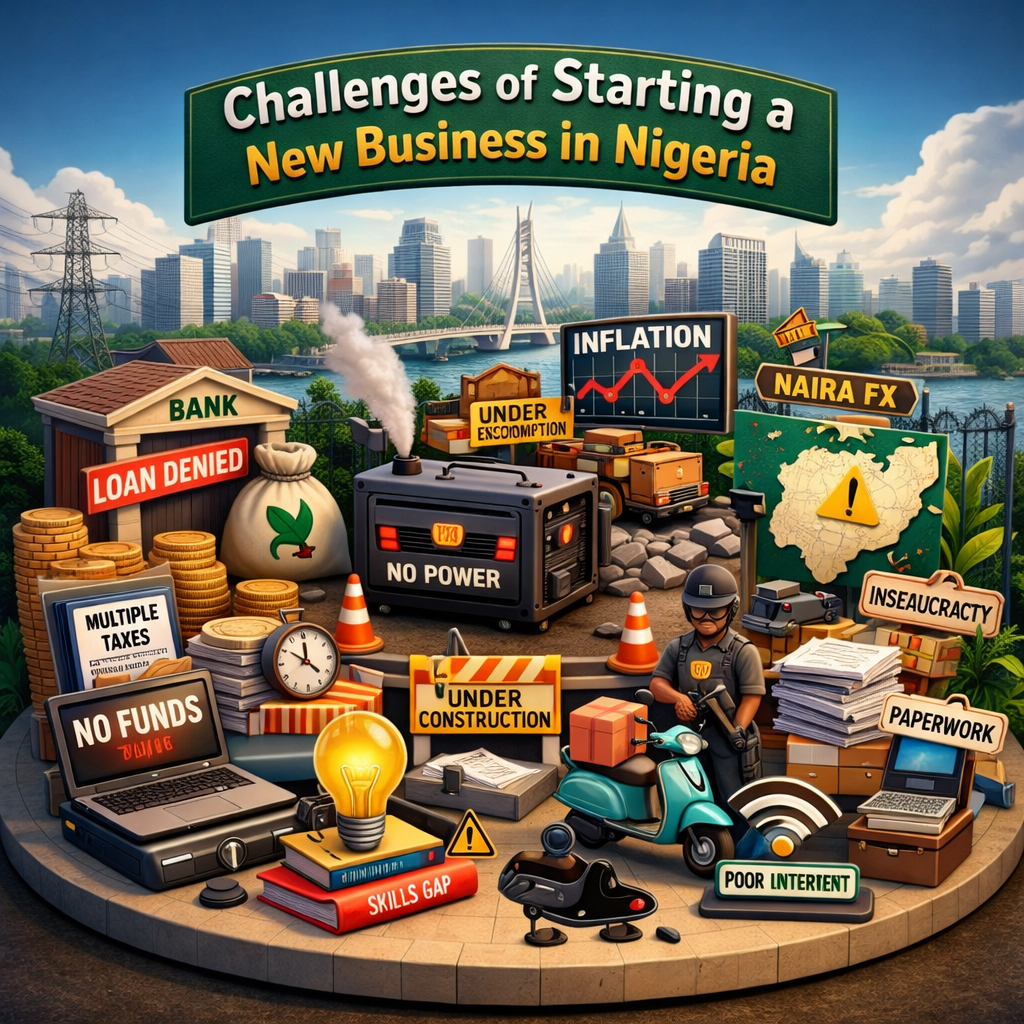
Table of Contents
1. Why Entrepreneurship Is Critical to Nigeria’s Economy
Before examining the challenges of starting a new business in Nigeria, it is important to understand the sector’s significance. Small and medium enterprises dominate Nigeria’s business landscape and serve as the backbone of employment and innovation.
SMEs account for about 96% of businesses in Nigeria and contribute significantly to national GDP while providing large-scale employment opportunities.
This means that despite the challenges of starting a new business in Nigeria, entrepreneurship remains one of the most practical pathways to financial independence and economic growth.
2. Access to Finance: The Biggest Barrier to Startup Survival
One of the biggest challenges of starting a new business in Nigeria is access to affordable funding. Many Nigerian entrepreneurs depend on personal savings, cooperative societies, or informal loans.
Recent reports show:
- Only about 4% of Nigerian MSMEs can access bank loans
- About 96% remain excluded from formal credit systems
- The financing gap is estimated at $236 billion
Additionally, surveys show that 35% of Nigerian businesses identify access to finance as their top challenge.
Real Case Study: Retail Startup in Lagos
A small electronics retailer in Ikeja (reported sector example) relied on family loans after banks demanded collateral worth more than the loan itself. The business delayed expansion by two years — a common reality in the challenges of starting a new business in Nigeria.
3. Power Supply and Energy Costs
Another major contributor to the challenges of starting a new business in Nigeria is unreliable electricity. Many startups must budget for generators, diesel, and maintenance.
Key findings show:
- Electricity is one of the biggest operating costs for MSMEs
- About 21% of businesses cite power as a major challenge
- Nigerian SMEs reportedly lose trillions of naira yearly due to generator costs and power disruptions
Real Case Study: Cold Room Business (Ikeja Example)
A cold-room storage business reportedly spends about ₦400,000 monthly on diesel, sometimes exceeding rent costs.
This illustrates the real operational pressure behind the challenges of starting a new business in Nigeria.
4. Multiple Taxation and Regulatory Pressure
Another hidden part of the challenges of starting a new business in Nigeria is regulatory complexity. Many startups face overlapping taxes from federal, state, and local authorities.
Reports show:
- Multiple taxation affects about 12% of Nigerian MSMEs significantly
- Policy inconsistency and levies create uncertainty for startups
For new founders navigating the challenges of starting a new business in Nigeria, this often results in compliance confusion and increased operating costs.
5. Inflation, Currency Volatility, and Economic Instability
Macroeconomic conditions are another major factor in the challenges of starting a new business in Nigeria. Inflation reduces consumer spending power, while currency fluctuations increase import costs.
Recent surveys show macroeconomic instability and inflation remain major constraints on business growth across sectors.
This makes pricing strategy extremely difficult — a key concern when considering the challenges of starting a new business in Nigeria.
6. Infrastructure and Logistics Challenges
Beyond electricity, poor road networks and logistics inefficiencies increase costs and damage goods.
Reports indicate:
- About 40% of Nigerian roads are in poor or critical condition
- Logistics delays increase fuel cost and product spoilage
These realities significantly contribute to the challenges of starting a new business in Nigeria, especially for e-commerce, agriculture, and manufacturing startups.
7. Skilled Labour and Talent Retention
Human capital issues also form part of the challenges of starting a new business in Nigeria. Many startups struggle to find skilled workers or retain trained staff due to migration or competition from larger firms.
Studies show inadequate skilled labour affects about 11% of MSMEs.
8. Security Concerns and Business Risk Exposure
Security issues, including theft, vandalism, and regional instability, also influence the challenges of starting a new business in Nigeria.
Some business surveys list insecurity among top structural constraints affecting SME performance.
9. Market Competition and Consumer Purchasing Power
While Nigeria has a large population, purchasing power varies significantly. Over half of MSMEs report declining sales due to low consumer spending.
This creates another layer in the challenges of starting a new business in Nigeria, especially for non-essential goods and premium services.
10. Digital Transformation and Technology Adoption Costs
Although Nigeria’s digital economy is growing, technology adoption comes with cost barriers such as internet infrastructure, payment system charges, and cybersecurity needs.
These factors further deepen the challenges of starting a new business in Nigeria, particularly for tech startups and online retailers.
How Nigerian Entrepreneurs Are Overcoming These Challenges
Despite the challenges of starting a new business in Nigeria, entrepreneurs are adapting through:
- Solar energy adoption
- Digital payments and fintech lending
- Cooperative funding models
- Social media marketing
- Lean startup strategies
These adaptive strategies show resilience against the challenges of starting a new business in Nigeria.
Future Outlook for Nigerian Startups
With policy reforms, fintech growth, and energy innovation, the business environment may improve gradually. However, systemic reforms are needed to fully reduce the challenges of starting a new business in Nigeria.
Conclusion
The challenges of starting a new business in Nigeria are multi-dimensional, covering finance, infrastructure, regulation, and macroeconomic conditions. However, Nigeria’s entrepreneurial spirit continues to drive innovation and job creation.
Understanding the challenges of starting a new business in Nigeria is the first step toward building resilient, scalable businesses that can survive and thrive in the Nigerian market.
References
- PwC MSME Survey – Energy cost, taxation, finance barriers – TheCable / PwC
- BusinessDay – Finance and power challenges affecting MSME growth
- Stears Report – MSME credit access and financing gap statistics
- Biznalytiq – Power cost impact and infrastructure realities
- SMEDAN / Within Nigeria – SME contribution to employment and GDP
- PwC MSME Survey 2024 – Sales decline, energy cost, taxation impact
- Punch – Generator dependence and electricity cost realities